Why Barn Doors Still Matter on LED Panels
Views: 0 Author: Site Editor Publish Time: 2026-11-18 Origin: Site


Introduction
The professional lighting industry has experienced a massive technological shift over the last decade. We have transitioned rapidly from hot, power-hungry tungsten fixtures to versatile and energy-efficient LED technology. With the ubiquitous rise of the modern Soft Panel, many videographers and gaffers began to question the necessity of traditional lighting modifiers. If an LED unit already produces a beautifully diffused spread of illumination straight out of the box, are traditional metal flaps still necessary?
From an engineering and on-set practical standpoint, the empirical answer is a resounding yes. The fundamental methods we use to generate illumination have evolved. However, these mechanical modifiers remain an indispensable tool on any professional set. A broad and diffused light source is incredibly flattering. Without physical boundaries, it becomes inherently difficult to manage. This comprehensive guide dives deep into why these classic tools still matter on modern fixtures. We will explore how they objectively compare to other control accessories and how they empower professionals to achieve precise cinematic setups.
Key Takeaways
Essential for Precision: Metal flaps remain the quickest physical barrier to flag off unwanted illumination from hitting backgrounds or causing veiling glare in your camera lens.
Diffused Sources Need Shaping: Modern LEDs provide gorgeous lighting. Their naturally wide beam angles require strict physical boundaries to prevent the scene from washing out entirely.
Asymmetrical Control: Grids limit the overall spread uniformly. Leaves allow for asymmetrical and highly directional flagging.
Gradient Shadow Edges: They create a smooth light fall-off that is highly desirable in modern cinematography, rather than harsh theatrical lines.
Physical Protection: Beyond shaping photons, they act as a durable physical shield for delicate surface-mounted diodes during rapid company moves.
The Evolution of Lighting and Current Industry Trends
To fully appreciate the current landscape of set illumination, we must briefly look back at the golden age of hard light. For decades, the industry standard relied heavily on traditional Fresnel and open-face tungsten luminaires. These fixtures produced highly directional, intense, and harsh beams. Because these units acted essentially as single point sources, mechanical flaps were absolutely mandatory. Gaffers relied on them daily to shape the hard output, control the intense spread, and protect the surrounding environment from extreme heat.
The introduction of LED technology completely changed the operational dynamics of set lighting. Modern fixtures offer built-in diffusion and remarkable energy efficiency. More importantly, they emit a naturally wide and wrapping light. Hundreds of small diodes spread across a large surface area work together to fill in shadows.
Recent industry trend analyses reveal a fascinating, paradoxical shift in the market. As high-output COB, or Chip on Board, and RGBWW LED panels become exponentially brighter, the search volume and market demand for robust light-shaping tools have actually skyrocketed. Professional cinematographers realize that raw, massive output is virtually useless without precision control. The inverse square law dictates that the wider a source is, the more likely it is to contaminate areas of the set where illumination is strictly unwanted. Uncontrolled lumens lead to washed-out contrast ratios and muddy color rendering. This is exactly why top-tier crews are returning to high-quality mechanical modifiers.
What Exactly Do Mechanical Modifiers Do on a Light Fixture?
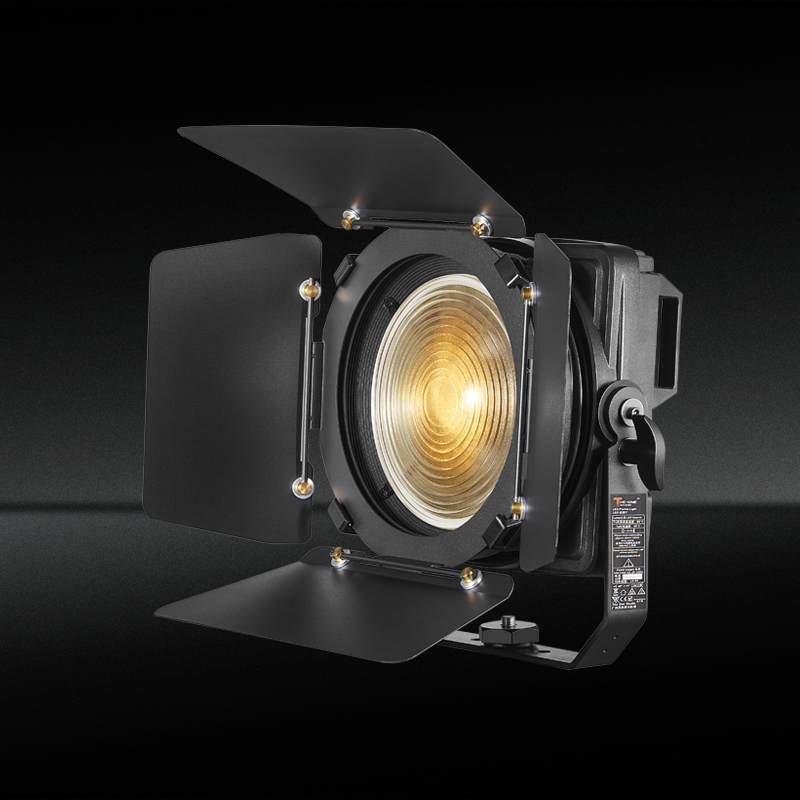
At their core, these accessories are straightforward but highly engineered modifiers. They consist of a series of opaque flaps. These are typically crafted from heat-resistant aluminum, steel, or advanced carbon fiber. They attach directly to the front bezel of a luminaire. Mounted on a rotating chassis, these leaves can be independently adjusted on tensioned hinges. Their primary function is not to focus the beam optically. Rather, they physically block photons from traveling in specific directions.
When selecting this tool, professionals generally choose between two primary configurations. A standard 4-leaf design features two large rectangular flaps and two smaller side flaps. This makes it lightweight and perfect for fast-paced documentary shoots. In contrast, an 8-leaf system incorporates additional triangular expansion flaps. These extra pieces bridge the mechanical gaps between the main leaves. This virtually eliminates frustrating corner light leaks when the doors are partially closed, which is a crucial feature for high-end commercial shoots requiring absolute precision.
The Primary Function: Mastering Spill Control
In professional visual storytelling, managing where the light does not go is frequently more important than managing where it does go. This philosophy is the essence of proper Spill Control. Imagine shooting a moody interview in a cramped corporate office. Your key light looks gorgeous on the talent's face. Unfortunately, its wide 120-degree output is simultaneously bouncing off a low white drop-ceiling. This completely destroys your carefully crafted contrast ratio. By simply angling the top leaf down by 15 degrees, you instantly kill that ceiling bounce. The lighting now serves the narrative rather than flattening the image.
Specifically, one of the most immediate practical applications on set is protecting the camera optics. Stray photons hitting the front element of a lens cause optical flares and a severe loss of micro-contrast. While matte boxes are standard practice, they are not always sufficient. By closing a single leaf on the side facing the camera, a lighting technician can instantly flag off the stray rays. This saves valuable floor space that would otherwise be required to rig an independent C-stand with a solid flag.
Visual storytelling relies heavily on directing the viewer's eye. Human attention is naturally drawn to the brightest part of a frame. By utilizing these adjustable flaps, cinematographers can effectively isolate their subjects. You can tweak the angles to keep the primary illumination strictly on your talent while physically blocking it from hitting the walls behind them. This technique allows the background to fall naturally into shadow, creating profound cinematic depth.
Modifier Showdown: Leaves vs. Grids
As LED technology matured, the honeycomb grid became an incredibly popular accessory. Commonly known as an Egg Crate, it attaches directly to the front of a diffused panel. Its primary function is to narrow the overall beam angle uniformly. Attaching a 40-degree grid to a native 120-degree fixture forces the micro-baffles to absorb off-axis rays. This results in a tighter, more directional forward beam.
While grids are phenomenal tools for controlling overall spread, they possess inherent operational limitations. A grid applies its restriction symmetrically across the entire fixture. It cannot block illumination asymmetrically. If you need to prevent illumination from hitting a specific window on the left side of the frame, a grid will reduce the window reflection, but it will also equally reduce the light hitting the right side of the room.
| Feature | Metal Leaves | Honeycomb Grid |
|---|---|---|
| Control Type | Asymmetrical, directional blocking | Symmetrical, uniform beam restriction |
| Light Loss | Minimal in the center beam | Noticeable reduction in overall output |
| Best Application | Flagging walls, protecting lenses, creating gradients | Narrowing the overall spread of a soft source |
| Physical Protection | Excellent when folded flat | None |
Consequently, professional gaffers rarely ask which modifier is superior. Instead, they deploy both simultaneously. The ultimate lighting setup often involves installing the grid to direct the general flow of illumination forward. Then, technicians utilize the metal leaves on the outer edge to provide the final asymmetrical flagging. This powerful combination grants surgical precision over the lighting environment.
Achieving the Perfect Cut with LED Panels
To master set lighting, one must deeply understand the physics of shadow creation. The hardness or softness of a shadow edge is determined by the physical size of the light source relative to the subject. Because a diffused panel features a large surface area, placing opaque flaps in front of it will never create a razor-sharp, theatrical Beam Cut. The photons simply wrap around the edges of the metal. Instead of a hard line, the modifier creates a beautiful graduated shadow edge. This smooth transition from light to dark is known as fall-off.
It is crucial to use the right tool for the specific creative job. If a director's vision requires a crisp and highly defined shadow line, a diffused panel is objectively the wrong choice. For high-contrast applications, professionals rely on dedicated hard sources. For example, utilizing a 200W High Brightness Compact Kit Daylight Fresnel LED Stage Light equipped with a manual zoom of 15 to 50 degrees allows the metal leaves to intersect concentrated rays. This produces perfectly defined shadow lines, mimicking harsh streetlamps slashing through Venetian blinds.
Furthermore, the soft gradient created by panel flaps is highly advantageous in contemporary cinematography. This gentle fall-off is perfect for simulating natural environmental lighting. Adjusting the leaves can flawlessly mimic the diffused ambient glow falling through a large living room window. Cinematographers frequently use these soft cuts to subtly vignette a frame. Gradually darkening the edges of the composition keeps the audience's focus anchored securely on the center of the screen.
Hidden Benefits on the Modern Set
Film sets and location shoots are notoriously fast-paced and hazardous environments. Equipment is frequently bumped and shoved into grip trucks. One of the most overlooked benefits of Barn Doors is their role as a physical shield. When a shoot wraps, the metal leaves can be folded completely flat over the front of the fixture. This creates a durable, rigid shell over the fragile surface-mounted diodes and delicate acrylic diffusion panels, safeguarding the expensive technology from accidental impacts.
Picture a frantic indie set where the Director of Photography suddenly asks for a splash of CTO to warm up a scene. Instead of halting production to rig a heavy C-stand with a dedicated gel frame, the gaffer can utilize the integrated metal clips found on many professional-grade leaves. Technicians can instantly clip a sheet of color gel or heavy diffusion paper directly across the front of the unit. This integrated feature saves valuable time and eliminates unnecessary grip clutter.
Time is arguably the most expensive commodity on any production. Setting up external light-blocking tools requires fetching the gear, setting the stand, bagging it for safety, and carefully positioning it. In stark contrast, adjusting a leaf takes literally one second. A cinematographer can reach out, tweak the angle by a few degrees, and instantly refine the setup. This speed advantage allows crews to maintain creative momentum.
Engineering Guide: How to Choose the Right Modifiers
Not all modifiers are constructed equally. Their material composition heavily dictates performance and longevity. From an engineering perspective, here are the critical factors you must evaluate before outfitting your lighting package:
Material Integrity: Historically, steel was heavily utilized for its durability, but it is exceptionally heavy. Today, high-grade extruded or die-cast aluminum alloys are the undisputed industry standard. Aluminum is favored because it is incredibly lightweight, preventing the light stand from becoming dangerously top-heavy. It also boasts excellent thermal conductivity, helping to dissipate the heat generated by high-output fixtures.
Mounting Mechanisms: Compatibility is the most critical factor. Diffused panels come in various proprietary shapes and sizes. Before investing, ensure the modifier is engineered specifically for your fixture's brand and model. Look for robust slide-in tracks or heavy-duty snap-on locking clamps. These provide a perfect balance of deployment speed and on-set safety.
Interior Optical Coating: The interior finish of the metal flaps is a seemingly small detail that makes a massive optical difference. The inside surface must be treated with a high-temperature matte black powder coating. If the interior is glossy, the illumination emitted from the panel will reflect off the inside of the flaps and bounce unpredictably into the scene. A premium matte black interior absorbs scattered photons, ensuring your intended shaping remains accurate and clean.
Conclusion
Even as lighting technology advances at a breakneck pace, the fundamental physics of light remain completely unchanged. A modern diffused panel offers incredible convenience, stunning color accuracy, and beautiful illumination. However, without the ability to control exactly where those photons travel, your images will ultimately lack depth, separation, and cinematic contrast. Mechanical flaps are absolutely not a relic of the past. They are a vital, necessary companion to modern LEDs.
Whether you are aiming for precise spill management, a soft gradient cut, or simply need to protect your expensive fixture on the go, investing in high-quality shaping tools is crucial. For professionals looking to upgrade their lighting arsenal with fixtures that offer superior control, high CRI/TLCI ratings, and robust build quality, explore the comprehensive range of stage and studio lighting solutions at The One Studio. Equipping yourself with the right gear ensures you are always ready to execute your creative vision with surgical precision.
FAQ
Can I get a hard shadow line using metal leaves on a soft LED panel?
No. Because a diffused panel has a large surface area and emits scattered light, the modifier will create a soft, gradual transition rather than a sharp, defined shadow line. The light naturally wraps around the edges of the metal. For hard theatrical cuts, you must utilize a hard light point source, such as an LED Fresnel fixture.
Do these modifiers reduce the overall brightness of my LED panel?
They only reduce the brightness in the specific areas where you are actively blocking the illumination. The light hitting your main subject in the center of the beam will remain largely unaffected. This differs from a honeycomb grid, which sits in front of the entire light-emitting surface and noticeably reduces the overall photometric output.
If my LED panel comes with a grid, do I still need adjustable flaps?
Yes, because they serve fundamentally different optical purposes. A grid limits the overall spread of light uniformly across all axes. Metal flaps allow you to block light asymmetrically. If you need to block light only from hitting the ceiling to maintain contrast, only adjustable leaves can achieve this specific directional blocking.
Are they heavy enough to make my light stand unstable?
Most modern versions designed for LED panels are manufactured from lightweight aluminum alloys to minimize weight. Adding any physical modifier shifts the center of gravity of the fixture forward. It is always highly recommended to properly balance your fixture on its yoke and strictly adhere to safety protocols by placing sandbags on the base of your light stands.
Can I attach gels directly to the flaps?
Yes. Many professional-grade models come equipped with built-in spring clips specifically designed to hold color gels or extra diffusion material. This makes them incredibly versatile on set, allowing you to modify the color and quality of the light rapidly without needing separate gel frames or additional heavy grip equipment.
How do I fix light leaks around the edges of my barn doors?
Light leaks typically occur at the corners where the flaps meet. Upgrading to an 8-leaf design with triangular expansion flaps is the most effective mechanical solution. For temporary on-set fixes, gaffers commonly use black wrap, also known as cinefoil, folded over the corners to seal off any rogue light rays escaping from the hinges.
Are traditional modifiers compatible with modern RGBWW LED panels?
Absolutely. The physics of light blocking apply regardless of the color temperature or hue emitted by the diodes. In fact, using them on RGBWW panels is highly recommended. When painting a set with saturated colors, controlling spill is even more critical to prevent unwanted color mixing and muddy shadows on your background.


