
When Does an Audience Blinder Need More Output
Views: 0 Author: Site Editor Publish Time: 2026-11-11 Origin: Site


Have you ever felt the sudden rush of a concert light? The undeniable impact of a perfectly timed blinder moment during a live theatrical performance serves as a cornerstone of modern production design. When executed with precision, this sudden burst of illumination controls the room's energy. It dissolves the physical boundary between performers and the crowd. Imagine a touring band hitting the dramatic crescendo of their biggest hit. If the crowd-facing fixtures fail to cut through the venue's darkness, that anticipated emotional peak simply fizzles out. An underpowered Audience Blinder falls flat, leaving the intended visual punctuation entirely unnoticed by spectators.
To prevent such technical letdowns, lighting designers must thoroughly evaluate specific environmental and architectural variables. These factors dictate when a lighting rig demands significantly higher luminous flux. This comprehensive guide explores the empirical reasons behind output requirements. We cover everything from calculating physical distances to integrating cutting-edge LED technology for maximum visual impact.
Key Takeaways
Distance Dictates Power: The further your lighting fixtures are positioned from the crowd, the exponentially higher the output required to maintain a blinding effect due to the inverse square law.
Screen Competition: Massive, high-brightness LED video walls easily wash out standard luminaires, necessitating high-output alternatives to slice through visual noise.
Daytime & Outdoor Challenges: Outdoor festivals and daytime events require maximum lumen punch to compete with natural ambient sunlight.
Versatility Matters: Modern high-output blinders can double as effective ambient lighting, provided they feature flawless dimming resolution and precise color temperature control.
Understanding the Core Purpose of an Audience Blinder
What is an Audience Blinder?
In the realm of stage production, an audience blinder is a specialized luminaire engineered specifically to illuminate spectators rather than performers. Its primary function is to create visual punctuation and build hype during musical drops. Unlike spotlights or profile fixtures focusing on precision optics, blinders flood a space instantly with raw, wide-angle illumination.
The Psychology of the Blinder Moment
The effectiveness of this lighting effect roots deeply in human physiology. Sudden bursts of bright light trigger immediate sensory responses. This environmental shift elevates physical energy and adrenaline within a crowd, transforming passive observers into active participants.
Halogen vs. Modern Solutions
Historically, the industry standard for achieving this adrenaline-pumping effect was the traditional DWE tungsten halogen blinder. While undeniably effective, these vintage fixtures required massive power draws and generated hazardous heat. Today, the production world has rapidly shifted toward high-output LED solutions. Modern fixtures achieve the exact same visual punch without the logistical nightmares associated with traditional halogen power consumption.
Factor 1: Long Throw Distance and Large Venue Sizes
The Inverse Square Law in Stage Lighting
When stepping from theoretical design into practical application, technicians must confront the laws of optical physics. The inverse square law dictates how light intensity drops exponentially as it travels through space. In simple terms, if the distance between the light source and the audience doubles, the light output spreads out. Its intensity weakens to a mere one-quarter of its original strength. This physical limitation is the primary reason why output requirements scale so aggressively as venue sizes expand.
Arena vs. Club Requirements
Consequently, the luminous needs of a 500-capacity indoor club differ vastly from those of a 15,000-capacity arena. In an intimate club setting, the distance from the lighting truss to the back of the crowd might only be 10 to 15 meters. Here, standard-output fixtures prove perfectly adequate. However, in massive stadiums, the Throw Distance—the physical gap from the rigging to the furthest rows—can easily exceed 50 to 100 meters. To achieve the exact same visual shock value at the back of an arena, the fixture demands a monumental increase in raw lumen output.
Calculating Your Necessary Output
Lighting professionals must meticulously match fixture wattage to the estimated throw distance of the venue. Below is a generalized reference demonstrating how output requirements scale with distance:
| Venue Type | Estimated Throw Distance | Recommended Output Level |
|---|---|---|
| Small Club / Theater | 5 - 15 Meters | Standard 50W to 100W per cell LED |
| Mid-Sized Music Hall | 15 - 30 Meters | High 100W to 150W per cell LED |
| Arena / Stadium | 30 - 100+ Meters | Ultra-High 200W+ per cell LED |
Factor 2: Competing with High-Nit LED Video Walls
The Rise of the LED Screen Background
Beyond the physical dimensions of a room, modern stage designs introduce their own set of luminous hurdles. Contemporary tours rely heavily on massive, ultra-bright LED video panels serving as dynamic backdrops. These screens display high-resolution graphics and atmospheric video content. While visually stunning, they emit a tremendous amount of ambient light. Operating at high nit levels completely alters the baseline brightness of the performance space.
The Washout Effect
If a crowd-facing luminaire lacks sufficient output, a bright video wall will completely overpower it. When a blinder cue triggers against a backdrop of high-nit screens, an underpowered fixture resembles a dim flashlight. The intended explosive visual effect is swallowed entirely by the ambient digital glow.
Matching Intensity and Industry Trends
Furthermore, analyzing recent industry trajectories reveals a clear arms race in stage production brightness. Live event designers are increasingly deploying massive 4K and 8K LED volumes pushing well beyond 4,000 nits. Lighting manufacturers are forced to respond with ultra-high-output fixtures just to keep up. Current market data indicates that standard crowd luminaires are no longer sufficient for top-tier tours. Designers now consider the video wall's maximum luminance as the absolute baseline. Blinders must aggressively surpass this baseline to register visually with the audience.
Factor 3: Outdoor Festivals and Daytime Performances
Fighting the Sun
While indoor environments present challenges with video walls, outdoor performances introduce the most formidable competitor of all: the sun. Natural daylight provides an overwhelming baseline of illumination. This ambient light often reaches 100,000 lux on a clear day, which standard theatrical fixtures simply cannot penetrate. During daytime events, traditional stage lighting frequently becomes completely invisible.
The Need for Extreme Punch
Because of this intense natural light, outdoor rigs require the absolute highest possible output for a blinder to register visually before dusk. Picture a highly anticipated festival set occurring at mid-afternoon. Triggering a standard blinder will have zero effect on the sun-drenched crowd. Only fixtures engineered with extreme punch and highly concentrated luminous flux can create a visible contrast against harsh daylight.
Weatherproofing and IP Ratings
Specifically, output is not the sole consideration for outdoor deployments. High-output outdoor blinders must also feature robust IP65 ratings. These fixtures must be hermetically sealed against dust ingress and sudden rainstorms. Surviving unpredictable festival conditions without compromising electrical integrity is crucial for any touring production.
Dual-Purpose Rigging: Using High-Output Blinders for Stage Wash
Maximizing Your Lighting Budget
From a practical standpoint, modern lighting designers are frequently tasked with doing more with less. Utilizing fixtures for multiple purposes is a standard industry practice designed to save precious truss space and maximize production budgets. A high-output blinder serves as an excellent candidate for this kind of dual-purpose rigging.
Transitioning from Blinder to Stage Wash
When not actively flashing the crowd, a high-output fixture can be physically tilted downward toward the performance area. By dimming the unit via the lighting console, technicians can provide a wide, even Stage Wash. This technique provides a beautiful layer of base illumination for performers, seamlessly filling in harsh shadows left by narrower profile fixtures.
Why Output is Crucial for Wash Lighting
Blinders inherently possess a very wide beam angle designed to disperse light over a massive audience area. Because the photons spread so widely, the fixture must boast a remarkably high base output to maintain a usable intensity. An underpowered unit will simply dissipate into the darkness when asked to evenly illuminate a 40-foot wide stage.
The Shift to COB LED Audience Blinders for Maximum Impact
What is COB LED Technology?
To meet these escalating demands, the lighting industry has largely transitioned to COB LED technology for high-impact fixtures. Unlike older LED arrays utilizing multiple visibly separated diodes, Chip-on-Board technology mounts numerous LED chips tightly together directly onto a single substrate. This forms a single, unified lighting module.
Why COB is Perfect for Blinders
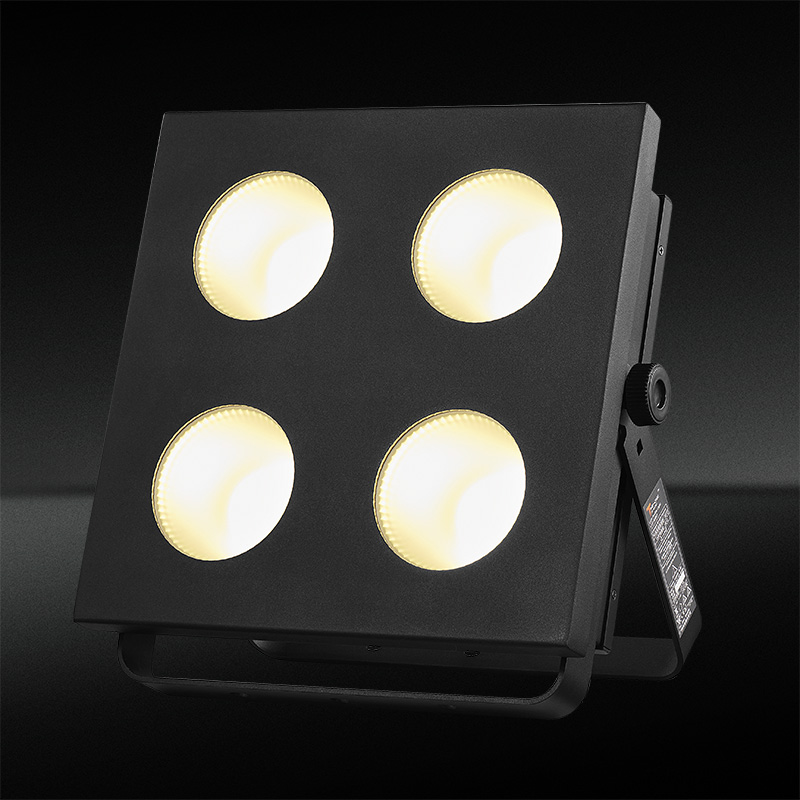
This manufacturing advancement offers incredibly dense light output from a relatively small surface area. For instance, a professional 2x2 audience blinder equipped with four 100W COB modules delivers a blinding punch that rivals traditional 2600W halogen units. It creates a single-shadow performance closely mimicking the organic look of traditional tungsten lamps. The unified light source prevents the disjointed look typical of older LED panels.
Energy Efficiency vs. Output
Perhaps the most significant operational advantage of COB technology is its energy efficiency. Venues and touring companies can now deploy dozens of high-output blinders on a single standard power circuit. This incredible efficiency completely solves the historical power-draw bottlenecks associated with vintage halogen rigs.
Why a Smooth Dimming Curve Matters for High-Output Blinders
The Danger of Steppy Dimming
When operating fixtures producing immense luminous flux, any flaw in the dimming software becomes glaringly obvious. If an ultra-bright fixture jumps instantly from zero to five percent intensity, the result is a jarring pop of light. This jagged dimming ruins delicate theatrical transitions and instantly breaks audience immersion.
Replicating the Tungsten Fade
To avoid these abrupt visual jumps, a high-resolution Dimming Curve is absolutely non-negotiable. Traditional halogen bulbs naturally take a fraction of a second to heat up and cool down. Modern high-output LED fixtures utilize advanced 16-bit processing to replicate this organic behavior. This allows the LED to decay into darkness with absolute precision.
Control at the Bottom End
A refined dimming curve also empowers a designer to use these powerful fixtures subtly. Professionals frequently need to run high-output blinders at a mere one to ten percent intensity. This provides a warm ambient background glow during acoustic sets. Without superior dimming resolution, the fixture will flicker or snap off entirely at these low levels.
How to Choose the Right Audience Blinder for Your Setup
Assessing Your Venue and Rig
Selecting the correct fixture requires a systematic assessment of your specific production environment. Buyers must ask practical questions regarding their typical venue sizes and environmental exposures. Will the fixtures need to aggressively compete with a massive LED video wall?
Warm White vs. RGBW Options
Designers must also make deliberate choices regarding color temperature. Traditional warm white fixtures calibrated around 3200K are ideal for achieving that classic rock-and-roll aesthetic. Conversely, RGBW high-output blinders offer immense color-changing versatility. This allows the blinder to perfectly match the specific color palette of a corporate brand or an electronic dance music stage design.
Evaluating Fixture Specs
When reviewing a specification sheet, look past marketing jargon and focus on objective engineering data. Pay close attention to the wattage per cell. A fixture with 100W COB cells will deliver significantly more punch than standard low-wattage alternatives. Evaluate the beam angle to ensure necessary coverage. Verify the IP65 rating if outdoor use is anticipated. Finally, check the DMX channel modes to confirm it supports 16-bit dimming for professional-grade control.
Ultimately, an audience blinder demands more output when navigating long throw distances, battling bright video walls, or competing with daytime sunlight. By investing in premium COB LED fixtures, you ensure your lighting rig remains versatile and future-proofed. Take the time to evaluate your current setup and calculate your throw distances. If you are ready to upgrade your crowd luminaires, explore the professional-grade solutions at The One Studio to guarantee your next live event leaves a lasting, electrifying impact.
FAQ
Q: Can I use an audience blinder as a stage wash?
A: Yes. With a high enough output, a wide beam angle, and a smooth dimming curve, an audience blinder can be effectively utilized as a warm or cool stage wash. Because the light spreads widely, a high base luminous flux is required to ensure the wash remains bright and even across the performance area, making it a highly versatile tool in your lighting arsenal.
Q: What is the main advantage of a COB LED audience blinder over halogen?
A: COB LED blinders provide the same or greater output as traditional halogen lamps but consume only a fraction of the electricity. Furthermore, they generate significantly less heat, reducing cooling costs and stage hazards, while offering modern features like instant strobe effects and pixel mapping without the need for heavy, expensive external dimmer racks.
Q: How does throw distance affect the type of blinder I need?
A: Because of the inverse square law, light intensity decreases rapidly over distance. A long throw distance, such as in an arena or stadium, requires a blinder with exponentially more output to achieve the same visual impact on the crowd as a lower-output fixture would in an intimate club. Failing to account for this physical reality results in a weak, ineffective lighting effect.
Q: Why is the dimming curve important for LED blinders?
A: A high-quality, 16-bit dimming curve ensures the light fades in and out smoothly without flickering or suddenly snapping off at low intensities. This is crucial for replicating the natural, lingering glow of traditional tungsten blinder effects. It also allows ultra-bright fixtures to be used safely at very low intensities for subtle theatrical moments without jarring visual steps.
Q: What IP rating is required for outdoor audience blinders?
A: For outdoor festivals and events exposed to the elements, an IP65 rating is the industry standard. This rating ensures the fixture is completely protected against dust ingress and can withstand low-pressure water jets from any direction, making it safe to operate during sudden rainstorms without risking electrical failure.
Q: How many DMX channels do modern LED blinders typically use?
A: The number of DMX channels varies based on the fixture's capabilities. A basic warm white blinder might use as few as 1 to 4 channels for master dimmer and strobe functions. However, advanced RGBW fixtures with pixel-mapping capabilities and 16-bit dimming can require 10 to 20 channels or more, giving lighting programmers granular control over each individual COB cell.


