LED Profile Spotlight for Broadcast and Film: How PWM, Color Mixing and Lens Angle Affect Camera Results
Views: 0 Author: Site Editor Publish Time: 2026-09-28 Origin: Site


The human eye is remarkably forgiving. High-definition cinema sensors, however, are ruthlessly precise. A lighting setup might look vibrant and flawless to a live studio audience. Yet, it can easily translate into a pulsing, color-shifted nightmare on the director’s monitor. Poor illumination ruins a carefully orchestrated shot faster than a missed line of dialogue. Therefore, selecting professional studio fixtures is a critical technical decision, not a mere afterthought.
At the center of this demanding environment is the LED Profile Spotlight. Often regarded as the ultimate precision tool for shaping light on set, this fixture does much more than simply blast a subject with brightness. Buying a light based solely on its raw lumen output is a costly amateur mistake. True broadcast-quality illumination relies on a complex interplay of internal electronics, optical physics, and advanced color science.
Understanding the underlying mechanics of modern lighting is essential for any technical director or studio buyer. By breaking down how Pulse Width Modulation, sophisticated multi-color mixing engines, and specific lens angles dictate how a camera sensor interprets a scene, professionals can confidently select the exact fixture required for their production needs.
Key Takeaways
High Refresh Rates are Non-Negotiable: A high Pulse Width Modulation frequency is the absolute baseline for achieving a truly flicker-free image. This prevents visual banding on camera sensors during high-frame-rate captures.
Color Science Matters: Upgrading to a modern multi-color engine provides superior skin tone rendering. It delivers higher index scores compared to legacy RGBW fixtures by filling crucial gaps in the color spectrum.
Optics Dictate Control: Selecting the appropriate lens angle ensures razor-sharp gobo projections and clean framing shutter cuts. It also guarantees optimal throw distance without unwanted light spill.
Silence is Golden: In professional studio environments, advanced thermal management is just as critical as photometric punch. Intelligent cooling prevents fan noise from ruining sensitive audio takes.
The Critical Role of the LED Profile Spotlight in Broadcast Lighting
What Makes a Profile Spotlight Unique?
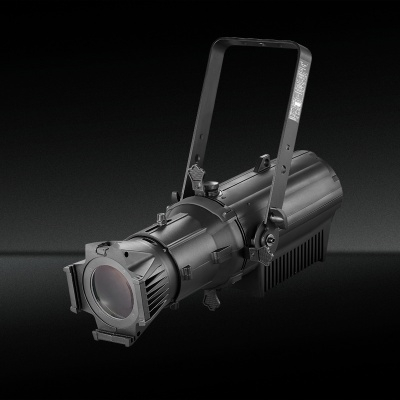
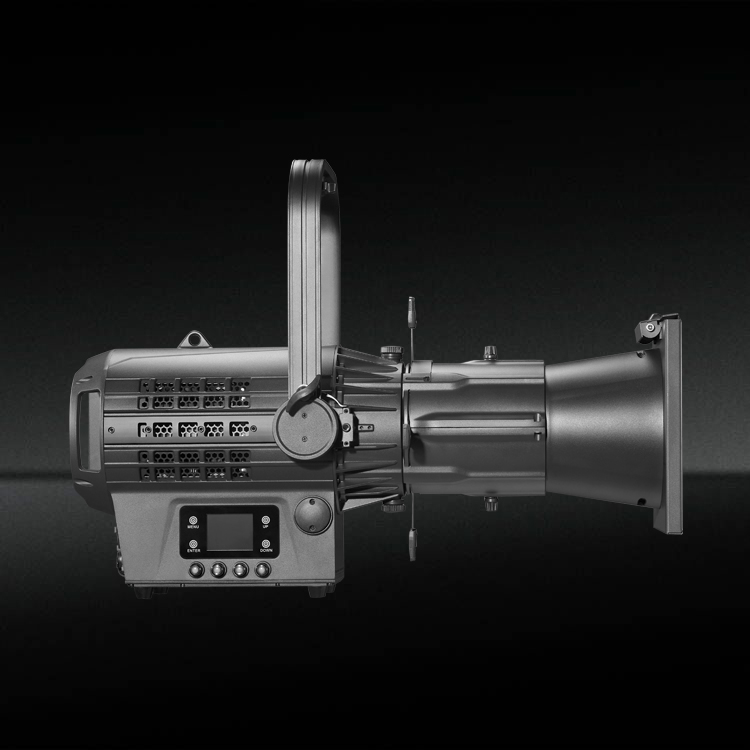
Unlike standard wash lights that flood a broad area with soft, unfocused illumination, the profile spotlight is a precision optical instrument engineered for absolute beam control. Industry professionals frequently refer to this tool as an LED ellipsoidal light. Its internal architecture is remarkably complex. The core components include a high-density LED engine, an internal reflector, a gate housing four adjustable framing shutters, a dedicated slot for pattern projection, and an interchangeable lens tube.
This specific combination of features allows Directors of Photography to carve light with geometric precision. Whether the goal is isolating a news anchor against a busy newsroom backdrop or projecting a crisp window blind shadow across a cinematic set, the profile fixture acts as the cinematographer’s scalpel.
Why Studios are Ditching Halogen for LED
The massive industry transition from traditional tungsten-halogen fixtures to LED technology is driven by measurable efficiency and operational cost reductions. Traditional halogen bulbs are notoriously inefficient. They convert a massive portion of their drawn energy into heat rather than usable light. By replacing these legacy units with modern LED fixtures, television studios significantly reduce their ambient heat output.
Furthermore, this reduction in thermal load directly lowers the operational costs associated with heavy-duty studio HVAC systems. Beyond thermal benefits, integrating modern broadcast lighting allows for instantaneous color temperature adjustments and native color mixing via the lighting console. This completely eliminates the recurring costs of physical gel filters and the time-consuming labor required for a technician to climb a ladder and swap them out between takes.
PWM Frequency: The Secret to a Flicker-Free Image on Camera
Understanding Pulse Width Modulation
To grasp why some lights look terrible on camera, one must first understand how LEDs actually dim. Because light-emitting diodes do not dim smoothly by simply lowering the electrical voltage like a glowing tungsten filament, they rely on a technique called Pulse Width Modulation. The fixture achieves dimming by turning the LED on and off at incredibly high speeds. The ratio of "on" time to "off" time dictates the perceived brightness. While the human brain effortlessly blends these rapid micro-flashes into a continuous stream of light, digital camera sensors operate under entirely different physical rules.
The Battle Between LED Refresh Rates and Camera Shutters
The interaction between an LED's refresh frequency and a camera's shutter speed determines whether a light will perform well on screen. Modern digital cinema and broadcast cameras utilize rolling shutters, scanning the image from top to bottom. If the LED's on and off cycle is too slow, it falls out of sync with the camera's frame rate and shutter angle.
This desynchronization manifests as dark horizontal banding rolling up the screen, aggressive strobing, or subtle flickering on the director's monitor. What appears as a perfectly solid, unwavering beam to the live studio audience can look like a failing, glitching bulb to the camera sensor. This completely ruins the usability of the footage.
What PWM Specs Should Buyers Look For?
When outfitting a studio, scrutinizing the refresh rate specification is mandatory. Many budget-friendly or architectural LED fixtures feature a frequency hovering around 1,200Hz. While perfectly adequate for a live theatrical stage play where no cameras are present, 1,200Hz will almost certainly cause banding on cameras shooting at higher shutter speeds.
To guarantee a flicker free stage light in a demanding broadcast environment, buyers must specify fixtures equipped with high-frequency or adjustable settings. Standard news broadcasts shooting at 24 or 30 frames per second require a minimum of 10,000Hz. However, for high-end commercial work or slow-motion capture exceeding 120 frames per second, professional fixtures must push further. High-power units, such as those engineered by top-tier manufacturers, now offer adjustable rates exceeding 25,000Hz to ensure absolute synchronization safety across any camera platform.
Color Mixing and Camera Sensors: Why the RGBALC Profile Light Wins
A major trend currently reshaping the broadcast and film lighting industry is the rapid adoption of virtual production and LED volumes. As studios increasingly rely on massive, curved LED video walls to render real-time digital backgrounds, the physical lighting on the actors must perfectly match the expansive color gamut of those screens. This shift has forced lighting manufacturers to prioritize high-fidelity, full-spectrum color engines over simple raw brightness. Foreground talent must blend seamlessly with virtual environments, demanding absolute color precision.
The Limitations of Traditional RGBW
Historically, early LED color mixing relied on a four-color diode system consisting of Red, Green, Blue, and White. While this system excels at producing highly saturated primary colors for concert stages, it suffers from severe spectral limitations when rendering continuous spectrums. It struggles specifically with natural white light and complex human skin tones.
These legacy arrays consistently exhibit a phenomenon known as the "cyan dip," which is a steep drop-off in output within the cyan wavelength. They also struggle immensely to produce rich, warm amber frequencies. On high-definition camera sensors, these spectral gaps result in skin tones that appear sickly, magenta-shifted, or unnaturally pale. This forces colorists to spend hours performing extensive post-production corrections.
Enter the RGBALC Revolution
To solve the inherent deficiencies of the four-color standard, optical engineers developed the six-color RGBALC profile light. This advanced engine incorporates Red, Green, Blue, Amber, Lime, and Cyan diodes.
The addition of Amber and Lime diodes fills the critical mid-spectrum gaps. This provides the warmth and luminous depth necessary to perfectly mimic traditional incandescent tungsten sources and the full spectrum of natural sunlight. Concurrently, the Cyan diode bridges the awkward gap between blue and green, effectively eliminating the notorious cyan dip. The resulting benefit is a continuous, full-spectrum light output that renders diverse human skin tones and wardrobe textures flawlessly, straight out of the camera.
Core Comparison: Legacy vs. Modern Color Engines
| Feature | Legacy RGBW Fixtures | Modern RGBALC Engines |
|---|---|---|
| Color Spectrum | Missing critical cyan and deep amber wavelengths | Full continuous spectrum mimicking natural sunlight |
| Skin Tone Rendering | Often magenta-shifted, sickly, or pale on camera | Flawless, natural warmth across diverse skin tones |
| TLCI Score | Typically hovers around 80 to 85 | Consistently exceeds 95 |
| Post-Production Impact | Requires heavy color grading and correction | Ready straight out of camera, saving editing hours |
Evaluating color science requires looking past marketing buzzwords and focusing on standardized metrics. For broadcast buyers, the Television Lighting Consistency Index is the superior standard. It specifically measures how a light source will perform when captured by a 3-chip broadcast camera sensor. A score above 95 is considered the baseline for professional broadcast. Modern 600W IP65 RGBALC fixtures easily hit these marks, offering the most accurate picture of a fixture's true capabilities.
Precision Beam Control: How Lens Angle Affects Your Shot
The Anatomy of a Profile Lens
The defining physical characteristic of a profile fixture is its protruding lens tube. The internal optics gather the raw, chaotic light emitted by the LED engine, pass it through the reflector and the gate where the shutters and gobos reside, and focus it into a coherent, manageable beam. The precision and quality of this glass lens system dictate the contrast ratio of the light and the absolute sharpness of the projected edge.
Fixed Lens Spotlight vs. Zoom Lenses
When configuring a studio grid, buyers frequently face the choice between fixed lenses and variable zoom lenses. In high-end broadcast and cinematic environments, a fixed lens spotlight is generally the preferred tool. Available in specific degrees such as 19, 26, 36, or 50 degrees, fixed lenses utilize fewer glass elements within the barrel. This streamlined optical path translates to superior optical clarity, higher overall light transmission resulting in more output, and significantly crisper edges for gobo projections.
Conversely, while zoom lenses offer the undeniable convenience of adjustable beam angles from a single fixture, they inherently sacrifice a small percentage of light output. The complex, moving glass elements inside a zoom barrel can also introduce slight edge softness and minor chromatic aberration, which appears as color fringing at the extreme edges of the beam.
Calculating Throw Distance and Beam Spread
Selecting the correct lens degree depends entirely on the physical dimensions of the studio space. Specifically, engineers must calculate the height of the lighting grid and the required throw distance to the talent. Narrow lenses between 10 and 19 degrees are ideal for long throw distances, such as punching a key light onto a news anchor from a high grid positioned far across a cavernous studio. Medium lenses between 26 and 36 degrees act as the standard workhorses for mid-range key and fill lighting. Wide lenses of 50 degrees and above are reserved for short-throw applications, such as splashing a wide texture onto a background set wall from a close distance.
Shaping the Light: Framing Shutters and Gobos in Filmmaking
While raw output and color accuracy are the foundational elements of a good light, the true value of a professional fixture lies in the operator's ability to manipulate that output. In professional broadcast environments, uncontrolled light spill is entirely unacceptable. It washes out contrast, introduces glare on glossy set pieces, and flattens the visual depth of a carefully designed scene.
Creating Depth and Texture
The internal framing shutter assembly is what elevates a profile light from a simple illuminator to a precision cinematic tool. Operators utilize these four independent metal blades to physically cut the light beam into specific geometric shapes. In a live news broadcast, this capability is crucial. A technician can brightly illuminate the presenter while precisely shuttering the light off the news desk surface to prevent glare on the teleprompter glass. They can also keep stray light off a nearby LED video wall to maintain deep black levels.
This precise, surgical control creates distinct zones of illumination. It establishes a clear separation between the foreground subject and the background, thereby adding three-dimensional depth to an otherwise flat set.
Gobos and Soft Focus
Beyond hard geometric cuts, these fixtures excel at adding organic texture to a scene through the gobo slot. Filmmakers frequently insert metal or glass patterns to project textures onto blank studio walls. Popular choices include venetian blind shadows, dappled tree leaves, or abstract architectural lines.
By simply sliding the lens barrel forward or backward, a lighting director can alter the focal length. They can choose to render these patterns with razor-sharp, hard edges for a dramatic film noir effect, or throw them slightly out of focus. A soft-focus projection creates a subtle, cinematic background texture that breaks up visual monotony and adds immense production value without distracting the viewer from the main subject.
The Unseen Factor: Thermal Management and Acoustic Noise
Why Heat is the Enemy of LED
Despite being vastly more efficient than traditional halogen bulbs, high-output LED engines still generate substantial thermal energy. Unlike tungsten which radiates heat forward with the light, LEDs generate heat backward, directly at the semiconductor junction base. If this thermal buildup is not aggressively managed, it leads to rapid thermal degradation.
Over time, excessive heat causes thermal droop, permanently reducing the fixture's maximum photometric output. More critically for continuous on-camera work, poor heat dissipation causes the LED's color temperature to shift unpredictably, usually drifting toward a green or magenta tint. Reliable, consistent performance requires robust internal heat sinks. Premium fixtures often utilize copper heat pipes and dense aluminum fin arrays to draw heat away from the diode effectively.
Protecting Your Studio Audio
In broadcast and film environments, pristine audio quality is just as important as the visual image. A massive, often overlooked pain point for studio engineers is the acoustic noise generated by active lighting cooling fans. If a lighting grid requires internal fans running at maximum RPM to prevent the LEDs from melting down, that high-pitched mechanical hum will inevitably be picked up by sensitive overhead boom microphones.
Astute buyers must prioritize fixtures equipped with intelligent thermal management systems. Look for features such as temperature-controlled, variable-speed fans that only spin as fast as necessary. Top-tier broadcast fixtures also feature dedicated silent modes. When engaged, the fixture slightly throttles the maximum LED output, allowing for completely fanless, sub-25dB silent operation during critical, dialogue-heavy audio takes.
Buyer’s Checklist: Choosing the Right LED Ellipsoidal Light
Transitioning a studio to modern LED standards represents a significant capital investment. Decision-makers must look past glossy marketing brochures and evaluate empirical, technical data. To ensure the chosen fixture meets the rigorous demands of professional camera sensors, use the following concrete standards for procurement:
Target Color Accuracy: Demand a Television Lighting Consistency Index rating greater than 95. This minimizes expensive post-production color grading.
Color Engine: Specify 600W RGBALC engines for dynamic, multi-color virtual sets. Alternatively, choose high-output Bi-Color engines for dedicated key lighting.
Refresh Frequency: Ensure the fixture offers adjustable rates exceeding 20,000Hz. This guarantees artifact-free operation on high-speed and cinema cameras.
Optics: Prioritize high-contrast glass lenses. Lean toward fixed lenses for maximum clarity and output, reserving zoom lenses only for positions where grid flexibility is paramount.
Acoustics: Verify the presence of intelligent fan control and a noise floor below 25dB for audio-sensitive environments.
Environmental Rating: Consider IP65-rated fixtures even for indoor studios. The sealed housing prevents dust accumulation on internal optics, drastically reducing maintenance downtime.
Conclusion
Ultimately, what looks vibrant and flawless to the naked eye is not always what the camera sensor records. The intricate combination of ultra-high refresh rates, advanced six-color mixing, and precise optical glass is what separates amateur stage lighting from professional, broadcast-quality illumination.
High-definition sensors expose every flaw. A subtle magenta color shift on an anchor's face, a soft edge on a shutter cut, or a rolling flicker caused by mismatched refresh rates can ruin a production. Investing in a high-quality LED profile spotlight is not merely about buying a brighter light. It is about acquiring a reliable optical tool that saves hours in post-production color grading and ensures flawless live television execution.
By prioritizing the technical specifications outlined in this guide, studios can future-proof their lighting grids and elevate their production value to cinematic standards. Evaluate your specific studio dimensions, camera requirements, and acoustic needs. For professionals seeking uncompromising quality, explore the high-power 600W IP65 RGBALC profile spotlights and other broadcast-ready solutions from THE ONE STUDIO, engineered specifically to perform flawlessly under the industry's most demanding conditions.
Frequently Asked Questions
What is the difference between an LED profile spotlight and a wash light?
The primary difference lies in beam control and optical design. A profile spotlight utilizes a complex lens system, internal framing shutters, and gobo slots to produce a hard-edged, sharply focused beam of light. This allows operators to cut light precisely around set pieces or project distinct patterns. In contrast, a wash light is designed to produce a soft, wide, and unfocused pool of light intended to fill large areas smoothly, without distinct edges or the ability to project shapes.
Why do my LED stage lights flicker on camera?
LED flicker on camera is caused by a mismatch between the camera's shutter speed and the light's refresh frequency. LEDs dim by turning on and off rapidly. If this cycle is too slow, the camera sensor captures the exact fractions of a second when the light is technically off, resulting in visible banding or strobing on the monitor. To resolve this, broadcast studios require fixtures with adjustable frequencies above 20,000Hz to ensure the light appears continuous to the digital sensor.
Is a fixed lens spotlight better than a zoom lens?
For rigorous broadcast and cinematic applications, fixed lenses are generally preferred over variable zoom lenses. A fixed lens contains fewer optical glass elements. This translates to higher light transmission, reduced color fringing at the edges of the beam, and vastly superior sharpness when projecting patterns or making shutter cuts. While zoom lenses offer the convenience of adjusting the beam angle without swapping physical lens tubes, they inherently suffer from slight light loss and softer edge definition due to their complex moving internal optics.
What does RGBALC stand for in broadcast lighting?
RGBALC stands for Red, Green, Blue, Amber, Lime, and Cyan. It represents an advanced LED color-mixing engine designed to overcome the spectral limitations of traditional four-color fixtures. By introducing Amber, Lime, and Cyan diodes, manufacturers can fill the missing wavelengths in the color spectrum, completely eliminating the cyan dip. This comprehensive spectral output perfectly mimics the continuous spectrum of natural sunlight, yielding exceptionally high index scores and resulting in flawless, natural skin tone rendering on camera without the need for corrective gels.
How many lumens do I need for a studio profile spotlight?
The required lumen output depends heavily on the throw distance from the lighting grid to the talent and the ambient light levels in the studio. However, for professional broadcast environments and cinematic key lighting, high-power 600W LED engines outputting upwards of 10,000 to 15,000 lumens have become the industry standard. This ensures enough punch to compete with bright LED video walls while allowing operators to stop down camera lenses for greater depth of field.
Can I use an IP65 profile spotlight indoors?
Absolutely. While an IP65 rating signifies that a fixture is weather-resistant and protected against water jets for outdoor use, it offers massive benefits for indoor studios. The completely sealed housing prevents studio dust, theatrical haze, and debris from accumulating on the internal LED engine and optical lenses. This sealed design eliminates the need for frequent internal cleaning, drastically extends the fixture's lifespan, and ensures consistent light output over years of daily operation.