330W vs 440W vs 600W Follow Spot Light: Choosing Power for Different Venue Sizes
Views: 0 Author: Site Editor Publish Time: 2026-09-29 Origin: Site


Imagine the climax of a live theatrical performance. The lead vocalist steps forward for a dramatic solo. Suddenly, the lighting struggles to cut through the heavy background wash. The emotional connection with the audience shatters instantly. In the realm of live production, lighting directs the audience's attention. A dedicated LED follow spotlight serves as the ultimate tool for maintaining that critical visual focus.
With the rapid advancement of light-emitting diode technology, selecting the appropriate fixture has become a complex engineering task for technical directors. Buyers frequently encounter wattage ratings such as 330W, 440W, and 600W. This often leads to confusion regarding how these electrical specifications translate into real-world brightness, beam intensity, and effective throw distance. Overestimating wattage causes unnecessary expenditures and harsh glare. Conversely, underestimating power results in performers blending seamlessly into the digital background set.
This comprehensive technical guide assists venue managers, technical directors, and lighting professionals in making an empirical, data-driven decision. By understanding the distinct optical capabilities of different power tiers, you can specify the precise hardware required for your venue dimensions and production demands.
Key Takeaways
330W Fixtures: Optimal for small venues, schools, and intimate clubs. They provide reliable performance for throw distances up to 30 to 50 meters.
440W Fixtures: The versatile industry standard for mid-sized regional theatres, houses of worship, and medium concert halls. These units are highly effective at 50 to 80 meters.
600W Fixtures: Engineered for large-scale arenas, stadiums, and professional touring stages. They deliver a high-intensity beam capable of reaching 80 to 120 meters and beyond.
Technological Efficiency: Modern diode fixtures deliver significantly higher lumen output per watt compared to legacy discharge lamps. They operate with drastically reduced heat and acoustic noise.
Strategic Matching: Aligning fixture wattage with venue dimensions prevents optical washout on small stages and ensures adequate illumination in massive architectural spaces.
What is a Follow Spot Light and Why Does Wattage Matter?
A follow spot is a manually operated, highly directional lighting fixture used to isolate and highlight a specific moving subject on stage. Unlike automated moving heads, it relies on a human operator to track unpredictable movements. This manual control makes it an indispensable component for live concerts, theatrical productions, and corporate keynote presentations.
The Evolution to the LED Follow Spotlight
Historically, the industry relied heavily on halogen and traditional HMI discharge lamps. While effective at the time, these legacy bulbs generated excessive thermal output, required heavy external magnetic ballasts, and suffered from rapid lumen depreciation.
Looking at current industry trends, the global stage lighting sector is undergoing a massive shift towards sustainability and operational efficiency. The push for carbon-neutral events is rapidly phasing out traditional discharge lamps. Major touring companies and fixed installations are standardizing on LED engines. This transition is not merely about saving electrical power. It is about eliminating the logistical nightmare of handling fragile, expensive replacement bulbs and managing extreme fixture temperatures. Today, a modern diode engine offers superior luminous efficacy. A 440W LED fixture can produce a comparable optical output to a legacy 1200W HMI fixture. This efficiency translates to lower power consumption and significantly reduced thermal output, dramatically improving safety for the operator perched in a cramped lighting booth.
How Wattage Impacts Throw Distance and Beam Intensity
In modern stage lighting, wattage indicates the electrical power consumed by the light engine. This directly correlates to the total lumen output. Yet, the critical metric for a live performance is lux, which measures lumens per square meter at a specific target distance.
As light travels through the air, it naturally disperses. A higher wattage engine generates a denser concentration of photons. This density allows the beam to travel further before losing its sharp edge and intensity. Consequently, higher wattage does not merely mean a brighter light up close. It signifies the fixture's mechanical capability to maintain a crisp, highly visible beam over an extended throw distance.
330W Follow Spot Light: The Best Choice for Small Venues
Serving as the compact, energy-efficient workhorse of the lighting industry, the 330W model is engineered for environments where space is limited. If your venue features older electrical infrastructure that cannot support heavy industrial loads, this tier is your baseline.
Ideal Throw Distance and Venue Match
For this power tier, the optimal target distance ranges from 30 to 50 meters, roughly 100 to 160 feet. At these distances, a stage follow spot provides a clean, well-defined circle of light. It easily isolates the subject without blinding the audience seated in the front rows.
These units are the standard specification for high school auditoriums, small comedy clubs, intimate black-box theatres, acoustic music venues, and modest hotel ballrooms. They often feature an adjustable color temperature ranging from 3200K to 5600K, ensuring versatility across different event types.
Pros and Cons
Weighing significantly less than their higher-wattage counterparts, these units boast exceptional portability. A typical 330W fixture weighs around 15 kilograms. They are easy to transport and can be securely mounted on standard lightweight tripod stands. Furthermore, their low power draw allows them to be plugged into standard wall outlets without requiring dedicated high-amperage circuits. This offers an accessible entry point for venues with strict budgetary constraints.
The primary limitation surfaces when competing with heavy ambient stage washes. If a production utilizes bright LED video walls or intensive moving-head beam shows, a 330W beam may struggle to cut through the visual noise. This results in a lack of contrast on the performer.
440W Follow Spot Light: The Versatile Mid-Size Performer
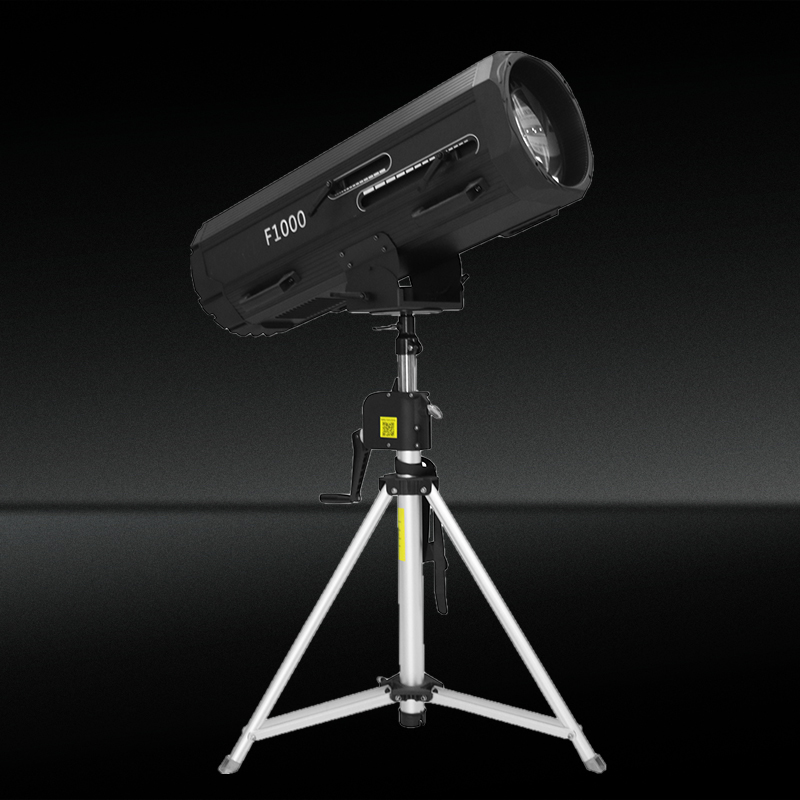
Positioned as the mid-tier option, the 440W fixture expertly balances robust optical power with manageable physical dimensions. It is widely regarded as the industry standard for general-purpose live event production.
Ideal Throw Distance and Venue Match
Engineered for an extended reach, the 440W target distance spans 50 to 80 meters. Typical applications include regional theatres, large houses of worship with broadcast requirements, mid-sized concert venues, university performing arts centers, and sprawling corporate event spaces.
Why the 440W is the Industry Standard
Technical directors frequently specify this model because it acts as an exceptional performer tracking light even under challenging lighting conditions. In contemporary stage design, lighting directors utilize intense backlighting and dynamic side-lighting to create depth. To ensure the lead performer remains the visual focal point, the tracking beam must be noticeably brighter than the surrounding wash. At 60 meters, a high-quality 440W engine can comfortably deliver over 1,500 lux, providing exactly this forward-facing punch.
While it packs more power, the fixture maintains a manageable physical footprint. A single technician can typically operate the unit smoothly throughout a two-hour show without experiencing severe physical fatigue. This ergonomic balance keeps labor costs and rigging requirements highly efficient.
600W Follow Spot Light: The Ultimate Long Throw Spotlight
When dealing with massive architectural spaces, standard fixtures suffer greatly from the inverse-square law of light. Intensity drops exponentially as distance increases. To combat this physical limitation, 600W and higher models are deployed as heavy-duty, professional-grade tools.
Ideal Throw Distance and Venue Match
These units are strictly engineered for extreme distances. They operate effectively between 80 to 120 meters and beyond. This level of uncompromising power is necessary for stadiums, large indoor sports arenas, massive outdoor music festivals, and professional touring shows.
Handling the Power of a 600W Fixture
Operating a 600W long throw spotlight requires specific infrastructural considerations. Because these fixtures generate immense optical power, they necessitate robust internal thermal management. Advanced models utilize liquid cooling or high-density copper heatsinks alongside high-RPM fans. This keeps the diode temperature stable, preventing thermal throttling during a three-hour arena show.
Physically, these units are substantial. They demand heavy-duty, counter-weighted stands equipped with precision bearings to allow the operator to pan and tilt flawlessly. Even a minor physical vibration at the fixture will translate to a massive, distracting shake of the beam 100 meters away on stage. Venues must also ensure dedicated power distribution planning is in place to guarantee stable voltage during peak output.
Head-to-Head Comparison: 330W vs 440W vs 600W
To facilitate an objective purchasing decision, it is crucial to compare these three wattage classifications across standard operational metrics. The data below reflects industry averages for professional-grade fixtures.
Quick Reference Comparison Chart
| Specification Metric | 330W LED Follow Spot | 440W LED Follow Spot | 600W LED Follow Spot |
|---|---|---|---|
| Effective Throw Distance | 30 - 50 Meters | 50 - 80 Meters | 80 - 120+ Meters |
| Average Fixture Weight | 15 - 20 kg | 25 - 35 kg | 45 - 60+ kg |
| Cooling System | Passive / Low-RPM Fan | Active Fan Cooling | High-Capacity Active / Liquid Cooling |
| Ideal Venue | Small Clubs, Schools | Regional Theatres | Arenas, Stadiums |
| Relative Cost Tier | Entry-Level / Budget | Mid-Range / Professional | Premium / Touring Grade |
Power Consumption and Operating Costs
When evaluating long-term financial return, modern LED fixtures present a stark contrast to legacy systems. A 600W LED draws approximately 2.7 amps on a 220V circuit. An equivalent 1200W HMI would draw over 5.5 amps, excluding the power lost as heat in the ballast. Over a multi-year lifespan in a frequently used venue, the reduction in electricity costs combined with a zero-maintenance LED engine results in a significantly lower Total Cost of Ownership.
Cutting Through Ambient Light
Lighting design relies heavily on contrast ratios. A standard engineering rule dictates that a follow spot must be at least two to three times brighter than the general stage wash to make the subject visually separate from the background. If your venue utilizes massive, high-nit LED video walls as backdrops, a 330W fixture will likely be overpowered. In such highly illuminated environments, upgrading to a 440W or 600W fixture becomes a technical necessity rather than a luxury. This ensures the performer remains distinct from the digital background.
Essential Features to Look For in Any Stage Follow Spot
Raw wattage is only one part of the equation. The mechanical and optical features of a theatre follow spot dictate how usable that power actually is in a live, high-pressure environment. When evaluating fixtures, technical buyers should scrutinize the following components.
Optical System: Iris, Zoom, and Focus
A premium optical system is non-negotiable. The quality of the glass lenses determines the clarity of the beam. A professional fixture must feature a smooth, mechanically precise iris. This allows the operator to instantly resize the beam from a wide, full-body wash illuminating a group of dancers down to a tight headshot for a solo vocalist. Additionally, independent linear zoom and manual focus controls are mandatory to maintain a razor-sharp edge as the performer moves closer to or further from the light source.
Color Temperature and CTO Filters
Most high-quality diode engines produce a native daylight color temperature, typically hovering around 5600K to 6500K. While excellent for general visibility, this cool white can appear overly harsh or blue on camera. Consequently, professional fixtures include built-in color wheels alongside critical CTO filters. A linear CTO filter seamlessly warms the light to around 3200K. This matches traditional incandescent theatrical lighting and ensures accurate, flattering skin tones for broadcast and video recording.
Cooling Systems and Acoustic Noise
Thermal management is directly tied to acoustic output. For a fixture positioned in a balcony directly above the audience, a loud cooling fan is entirely unacceptable. It will ruin quiet, dramatic moments during an acoustic performance. Always evaluate the acoustic noise rating of the fixture. Advanced models utilize intelligent, temperature-controlled fans or heat pipes to maintain optimal thermal levels without disrupting the audio production.
How to Choose the Right Power for Your Specific Venue
Making the final purchasing decision requires a systematic, environmental assessment of your specific performance space. Avoid guessing. Rely on physical measurements and established lighting principles.
Step 1: Measure Your Throw Distance
Do not estimate the distance. Grab a laser measure. Calculate the exact straight-line distance from the planned mounting position to the downstage edge, which is the closest point the performer will stand to the audience. This exact measurement serves as the primary data point needed to choose between the 330W, 440W, and 600W tiers, preventing costly specification errors.
Step 2: Assess Your Stage Wash
Evaluate your existing lighting inventory carefully. If your stage is lit by standard traditional PAR cans and minimal backlighting, a lower wattage spot will suffice. Conversely, if you regularly deploy high-output moving head washes, blinders, and LED screens, you must scale up your wattage to maintain the necessary brightness contrast ratio.
Step 3: Consider Operator Ergonomics
Factor in the human element. Higher wattage equates to larger, heavier internal components. Ensure that your operators can comfortably maneuver the fixture. A 600W unit requires a sturdy, well-balanced stand and a skilled operator to execute smooth tracking. If the fixture is too heavy or cumbersome for a volunteer operator to control precisely, the resulting jittery light will severely detract from the performance. In such cases, a lighter 330W or 440W model proves to be a much wiser choice.
Conclusion
Choosing the right lighting power ultimately depends on the unique dimensions and ambient brightness of your venue. A 330W unit works flawlessly for intimate, small spaces, offering incredible portability and value. The 440W model steps up as the versatile industry standard, providing exceptional punch for mid-sized regional stages. For massive arenas and outdoor festivals, a 600W fixture delivers the uncompromising brightness required for extreme long throws.
Always measure your throw distance accurately and evaluate your existing stage wash before making a purchase. If you are upgrading your venue's lighting infrastructure, selecting the precise hardware is critical. Explore the professional range of solutions at The One Studio to find the exact fixture tailored to your stage's dimensions and technical requirements, ensuring your performers always remain the shining focal point of the show.
FAQ
Can I use a 600W follow spot light in a small venue?
While it is technically possible by utilizing the mechanical dimmer to reduce output, it is highly impractical and generally considered overkill. The fixture will be unnecessarily heavy, occupy too much valuable space in a small booth, and represent a poor allocation of your equipment budget. Furthermore, even at its lowest dimming setting, the baseline intensity might still prove too harsh for performers standing at a short throw distance.
How does an LED follow spotlight compare to a traditional 1200W HMI spot?
A modern 440W or 600W LED engine can often match or even exceed the effective optical output of a legacy 1200W HMI fixture. The technological advantage includes consuming less than half the electrical power, producing zero ultraviolet radiation, generating significantly less ambient heat, and requiring no expensive, hazardous bulb replacements over its operational lifespan.
What is the lifespan of a 440W LED follow spot?
Most high-quality diode arrays utilized in professional stage lighting are rated for up to 50,000 hours of continuous use. For a typical venue operating the light for 20 hours a week, the light engine will easily outlast the mechanical components of the fixture. This virtually eliminates traditional lamp maintenance and replacement costs.
Do these follow spots require a special DMX controller?
While many modern fixtures feature DMX-in and DMX-out capabilities, allowing the main lighting console to control parameters like dimming or color changes, a controller is not strictly required. These units are fundamentally designed for manual, hands-on operation by a dedicated technician using the onboard physical faders, buttons, and iris controls.
What is the difference between an automated moving head and a manual follow spot?
Automated moving heads are programmed via a lighting console to hit specific coordinates on stage at precise times. A manual follow spot relies on a human operator to physically pan and tilt the fixture. This human element is essential for live performances where a singer or actor may improvise their movements, requiring real-time tracking that pre-programmed lights cannot achieve.
What Color Rendering Index should I look for in a follow spot?
For live events that are being broadcasted or recorded on video, you should look for a fixture with a Color Rendering Index above 90. A high Color Rendering Index ensures that the light accurately reproduces the performer's skin tones and costume colors, preventing them from looking washed out or unnaturally tinted on camera.


