2-Eye vs 4-Eye LED Blinder Light: How to Match Stage Size, Power and Audience Effects
Views: 0 Author: Site Editor Publish Time: 2026-09-29 Origin: Site


The undeniable energy of a live show often peaks in a single, defining moment. The music swells. The stage goes completely pitch-black. Suddenly, the crowd is hit by a synchronized, blinding burst of illumination. Achieving this visceral visual impact requires precise equipment selection and strategic lighting design.
As an event planner or technical director, you constantly face a critical choice when configuring your truss. Do you rely on a compact dual-lens unit? Or do you need a quad-lens powerhouse? The modern standard has shifted decisively toward solid-state technology. Old, power-hungry halogen fixtures are largely a thing of the past. This guide explores how to match your stage dimensions, electrical limits, and aesthetic goals to the perfect equipment. We will ensure your next production leaves a lasting impression.
Key Takeaways
Energy Efficiency: Modern LED units offer superior energy efficiency, drastically reduced heat output, and a significantly longer operational lifespan compared to traditional halogen fixtures.
Venue Matching: A dual-lens setup is the optimal choice for intimate stages, venues with low ceilings, and locations with strictly limited power capacities.
Maximum Output: The four-lens configuration delivers a massive punch and wider coverage. It is the standard choice for outdoor music festivals, arenas, and large-scale touring productions.
Advanced Control: Modern COB technology provides smooth dimming curves and pixel-mapping capabilities. This allows for advanced, dynamic crowd illumination.
Smart Rigging: Proper control programming is essential for executing professional lighting cues. This includes dynamic chases, rapid strobes, and the classic tungsten "fade-out" effect.
Understanding the Modern LED Blinder Light: From Halogen to COB Technology
To make an informed purchasing decision, you need to understand the technological shift that transformed concert production over the past decade. The fundamental requirement for illuminating a crowd remains constant. However, the engineering behind the fixtures has evolved drastically.
The Evolution of the Audience Light
Historically, the industry standard for a concert audience light was the DWE halogen blinder. These traditional fixtures produced a beautiful, warm color temperature and a natural fade-out effect. Yet, they came with severe logistical nightmares. Halogen units drew massive amounts of electrical current. Touring crews often required dedicated heavy-duty power distribution systems and standalone generators just to run the audience lights. Furthermore, they generated extreme heat. This posed safety risks and increased the ambient temperature on stage, while the fragile filaments required frequent, costly replacements.
Why the COB Stage Blinder is the New Industry Standard
The current benchmark in professional stage lighting relies on Chip-on-Board (COB) technology. This specific engineering approach mounts multiple LED chips tightly together directly onto a substrate. It forms a single, intensely bright module. As a result, the fixture perfectly mimics the warm, centralized, and uniform glow of a traditional halogen lamp. You get the classic look without the harsh glare or multiple shadows associated with older, first-generation LEDs.
More importantly, COB LEDs offer approximately 80% more energy efficiency than their halogen predecessors. Integrated heat sinks and low-noise active cooling fans ensure proper thermal dissipation. This smart thermal management extends the functional lifespan of the diodes to upwards of 50,000 hours.
Current Industry Trends: Scalability and Efficiency
Looking at the broader touring and installation market, production designers are increasingly prioritizing scalable, modular lighting rigs. The days of static, oversized, and power-hungry arrays are fading. Recent analyses of touring specifications show a distinct shift toward energy-efficient, adaptable setups. A modern rig must transition seamlessly from a mid-sized theater to a large amphitheater without exceeding strict power budgets. This evolution heavily favors intelligent LED configurations. They reduce environmental impact and transport weight, while still delivering the visceral crowd illumination expected at major live events.
The 2 Eye Blinder Light: Compact Power for Intimate Venues
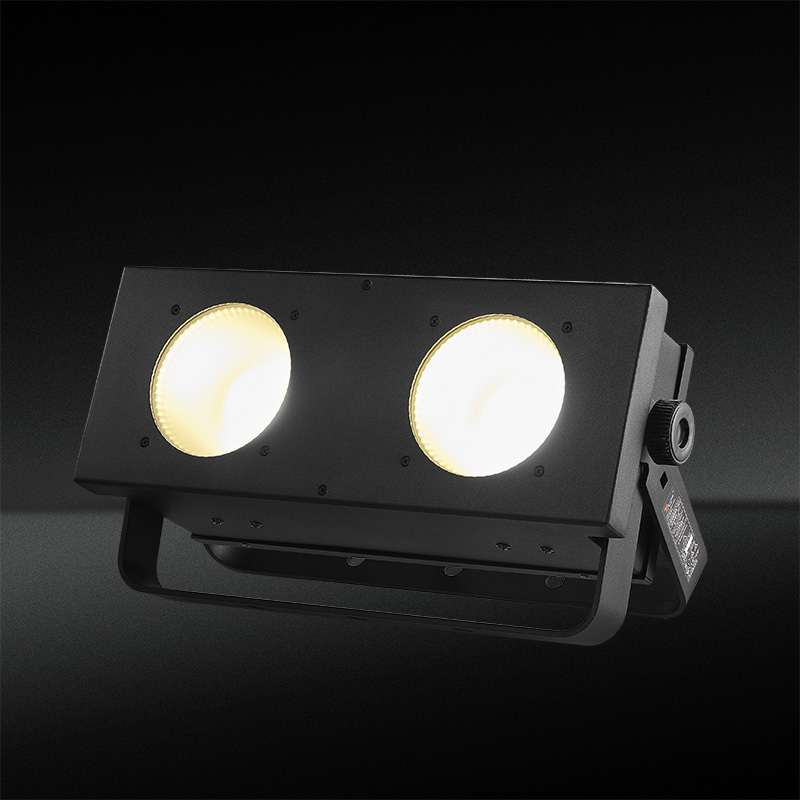
Designing a lighting plot for a small space comes with strict limits. Physical footprint and power availability will dictate your choices. The dual-lens configuration provides a measured, highly efficient solution for these specific architectural constraints.
Key Specifications and Wattage
A standard 2 eye blinder light typically features two 100W COB LED modules. This results in a total power draw of roughly 200 watts. From a physical standpoint, these units maintain a compact profile and generally weigh between 10 to 15 pounds. They often feature a wide 60-degree beam angle to provide an even wash over a short distance. This lightweight design drastically reduces the load on smaller aluminum trusses, vertical floor totems, or tight grid spaces. Specifically, it allows a single technician to handle the rigging and focusing process without requiring additional heavy lifting equipment.
Ideal Stage Sizes and Applications
Imagine a packed 300-capacity underground club. Rigging a massive quad-array here would blind the front row completely. That makes the compact dual-lens unit the perfect surgical tool. They are the logical choice for live music clubs, small theatrical spaces, houses of worship, and corporate event stages. In venues with low ceiling clearance (under 15 feet), a massive burst of light can easily overwhelm the room. The 2-eye variant provides enough punch to create the desired high-energy impact. Yet, it remains controlled enough to suit the visual scale of an intimate room without causing visual discomfort.
The 4 Eye Audience Blinder: Massive Output for Arena Shows
For large-scale productions, the primary objective is "throw"—the ability to project light across vast distances to illuminate thousands of people simultaneously. Here, lighting designers must scale up their equipment. This requires a fixture with substantial raw output and wide dispersion.
Doubling the Impact: Power and Output Metrics
A professional 4 eye audience blinder effectively doubles the photometric specifications of its smaller counterpart. Housing four 100W COB modules, these fixtures draw upwards of 400 watts. This arrangement not only increases the raw lumen output but also provides a wider, more dominant beam field. The combined intensity is specifically engineered to cut through heavy atmospheric haze. It easily overpowers ambient video wall brightness and the output of powerful moving head profiles on a busy stage.
When to Upgrade to a 4-Eye Fixture
Upgrading to a four-lens fixture becomes an absolute necessity when the physical dimensions of the venue exceed the throw capacity of smaller lights. The best use cases include outdoor music festivals, stadium tours, large mega-churches, and wide proscenium stages. In these demanding environments, lighting designers often rig these units in large matrices (e.g., a 4x4 grid) or linear arrays along the downstage truss. This configuration creates a towering wall of light. It ensures that even attendees in the farthest seating tiers feel the kinetic impact of the performance.
Stage Size vs. Fixture Choice: The Engineer's Selection Guide
Selecting the correct fixture is not purely a matter of budget. It is a calculated process of matching the photometric data of the light to the physical dimensions of the performance space. You want even coverage, not glaring hot spots.
Small to Medium Stages (Under 40 ft wide)
For stages under 40 feet in width, spacing out multiple dual-lens fixtures generally yields a vastly superior visual result than cramming in a few quad-lens fixtures. Evenly distributing smaller units along the truss closest to the audience ensures a uniform wash of light across the crowd. In contrast, using oversized fixtures in a small space often results in uncomfortable glare for the front rows, while leaving dark gaps in between the units.
Large Stages and Outdoor Festivals (Over 40 ft wide)
Once a stage exceeds 40 feet in width, or when the audience depth extends beyond 100 feet, larger fixtures become mandatory. The inverse square law of light dictates that intensity drops rapidly as distance increases. Therefore, to effectively reach the back of a sprawling festival crowd, you need the concentrated, high-lumen output of a four-lens unit to overcome the natural falloff of light.
Calculating the Number of Fixtures Needed
While every lighting plot is unique, production professionals often rely on standardized spacing rules to ensure adequate illumination. Below is a practical baseline for planning your downstage rig:
| Stage Width | Recommended Fixture Type | Estimated Quantity Needed | Recommended Spacing |
|---|---|---|---|
| 20 - 30 ft (Clubs/Small Stages) | 2-Eye Blinder (2x100W) | 4 to 6 units | Every 5 to 6 feet |
| 30 - 40 ft (Theaters/Mid-size) | 2-Eye or 4-Eye | 6 to 8 (2-Eye) or 4 (4-Eye) | Every 6 to 8 feet |
| 40 - 60 ft (Arenas/Large Venues) | 4-Eye Blinder (4x100W) | 6 to 8 units | Every 8 to 10 feet |
| 60+ ft (Outdoor Festivals) | 4-Eye Blinder (IP65 Rated) | 8+ units (often stacked) | Clustered arrays every 10 ft |
Maximizing Audience Effects with COB Technology
Beyond raw illumination, modern LEDs are highly versatile creative tools. Advanced internal software allows programmers to execute complex visual cues that older analog lights simply could not achieve.
The Classic "Blinder" Flash and Fade
The most iconic use of an audience light is the sudden, intense flash on a musical accent, followed by a slow, lingering fade to black. When a traditional halogen bulb loses power, the filament cools slowly, creating a distinct, warm delay. To achieve this organically, a high-quality COB stage blinder is equipped with selectable dimming curves. By selecting a "tungsten" profile, the internal processor artificially delays the dimming response. It warms the color temperature as the light fades, perfectly replicating the thermal cooling of a physical filament.
Strobe Effects, Chases, and Pixel Mapping
Because each COB module (or "eye") is an independent digital light source, programmers can achieve complex pixel mapping. Designers can execute rapid left-to-right sweeps, crisscross patterns, or high-frequency strobe effects without worrying about burning out a bulb. This independent control adds intense kinetic energy and dynamic movement to electronic dance music (EDM) or hard rock performances. It elevates the fixture from a static wash to an active effect light.
Color Temperature: Warm White, Cool White, or RGBW?
The choice of diode dictates the emotional impact of the light hitting the crowd:
Warm White (3200K): Replicates traditional halogen. It feels natural, inviting, and remains the standard for rock, country, and theatrical applications.
Cool White (5600K): Mimics daylight. It delivers a stark, high-contrast, and aggressive punch, often utilized in industrial, EDM, or metal shows.
RGBW (Red, Green, Blue, White): Full-color fixtures allow for non-traditional audience lighting. Instead of merely blinding the crowd with white light, designers can wash the audience in deep saturated reds or vibrant blues to match the specific mood of a song. This drastically expands the creative palette.
Rigging, Wiring, and Protocol Integration
Proper installation and data management are critical for ensuring safety and performance reliability during a live event. LED technology has streamlined the cabling process, but it requires a solid understanding of digital protocols.
DMX Channel Modes and Console Integration
A professional DMX blinder light communicates with the lighting console via standard 5-pin or 3-pin cables. They offer multiple channel modes to suit different programming constraints. A basic 1-channel or 2-channel mode allows for simple master dimmer and global strobe control—ideal for quick setups. Conversely, multi-channel modes (often 8 to 16 channels for a quad-lens fixture) unlock granular control. This allows the console to manipulate the intensity and macro effects of every single lens independently.
Power Linking and Daisy-Chaining Safely
One of the most significant empirical advantages of LEDs is the drastic reduction in amperage. A traditional 4-lamp halogen unit drew nearly 2,600 watts. That maxed out a dedicated 20A circuit for just one fixture! In stark contrast, a modern 400W LED unit draws less than 4 amps at 110V. Consequently, technicians can safely "daisy-chain" (power-link) up to four or five quad-lens fixtures, or up to ten dual-lens fixtures, on a single standard 20A circuit using locking power connectors. This eliminates the need for expensive external dimmer racks and heavy multicore cabling.
Mounting Angles for Maximum Impact
Rigging geometry directly affects both audience comfort and aesthetic impact. Fixtures should never be pointed directly parallel to the floor at eye level. This strikes the crowd with an uncomfortable, sustained glare. Best practices dictate mounting the units on a truss elevated at least 15 to 20 feet above the stage deck, tilted downward at a 30 to 45-degree angle. This trajectory ensures the burst hits the audience's sightline perfectly for the dramatic effect, while allowing them to look slightly downward to avoid visual fatigue.
Cost, Maintenance, and ROI for Production Companies
For purchasing managers and production company owners, the decision between fixture types must ultimately be justified by Return on Investment (ROI) and the total cost of ownership over the equipment's lifespan.
Initial Investment vs. Long-Term Savings
While professional-grade LED fixtures require a higher upfront capital investment compared to legacy halogen housings, the long-term arithmetic heavily favors the modern upgrade. The ROI is rapidly realized—typically within the first 12 to 18 months of active touring or rental use. How? Through the total elimination of expensive replacement lamps, drastically lower electricity bills, and reduced labor costs for maintenance and heavy cable runs.
Durability and IP65 Waterproof Options
When investing in inventory for cross-functional use (both indoor and outdoor), environmental ratings are a non-negotiable specification. Standard indoor units carry an IP20 rating and are highly vulnerable to dust and moisture. However, for production companies servicing outdoor summer festivals, purchasing IP65-rated waterproof fixtures is a strict requirement. These units feature sealed aluminum chassis and waterproof connectors. They ensure the lights continue to operate safely during heavy rain without the need for unsightly plastic domes, thereby protecting the company's financial investment in harsh touring conditions.
Conclusion
Because the dual-lens fixture fits small stages perfectly, it remains a highly versatile and budget-friendly staple for regional production companies and intimate venues. Meanwhile, the quad-lens version delivers unparalleled, massive power, solidifying its status as the undisputed king of large arenas and outdoor festivals.
Before finalizing your inventory, always evaluate your specific stage dimensions. Calculate your available power limits carefully, and consider the DMX control capabilities required for your show. By matching the precise scale of the fixture to your production needs, you can easily illuminate your crowd and make your next live event truly unforgettable.
Ready to upgrade your lighting inventory? Explore professional-grade solutions that fit your stage, power limits, and budget. Visit The One Studio to find the perfect LED blinder lights and stage equipment for your next major production.
FAQ (Frequently Asked Questions)
Q: Can a COB stage blinder replicate the "tungsten fade" of a traditional halogen blinder?
A: Yes. High-quality COB LED units feature built-in, software-driven dimming curves. These curves are specifically engineered to perfectly mimic the delayed, warm fade-out of a physical halogen bulb cooling down. This provides the classic, organic aesthetic without the massive power draw.
Q: How many DMX channels does a 4 eye audience blinder use?
A: It varies depending on the specific fixture and the selected operating profile. A simple setup might use 1 to 4 channels for master dimmer and global strobe. However, advanced pixel-mapping modes can utilize 8, 16, or more channels. This allows lighting designers to control the intensity and strobe rate of each eye individually.
Q: Can I mix 2-eye and 4-eye LED blinder lights on the same stage?
A: Absolutely. Many professional lighting designers use larger quad-lens fixtures on the main upstage and downstage trusses for massive forward punch. They then strategically place dual-lens fixtures on side trusses, vertical floor totems, or drum risers to create dynamic cross-lighting and layered visual depth.
Q: Are LED blinder lights safe for outdoor concerts?
A: Yes, provided you purchase specifically rated equipment. Standard indoor fixtures (IP20 rating) should only be used under heavily covered stages to protect them from moisture. For true outdoor use, you must invest in IP65-rated fixtures. These are completely sealed against rain, dust, and humidity, ensuring safe operation in unpredictable weather.
Q: What is the ideal beam angle for a stage blinder light?
A: For most live music applications, a 60-degree beam angle is considered ideal. This wide dispersion ensures a smooth, even wash of light across a large section of the audience, preventing harsh hot spots while maximizing coverage area.
Q: Can LED blinders be used as strobe lights?
A: Yes. Unlike traditional halogen bulbs that take time to heat up and cool down, modern COB LEDs have instant response times. This allows programmers to use them as high-intensity, high-frequency strobe lights, adding massive kinetic energy to EDM or rock performances.


