Full Color vs Bi-Color LED Soft Light: Which Works Better for Studio Production?
Views: 0 Author: Site Editor Publish Time: 2026-09-28 Origin: Site


Tungsten lights turn controlled shoots into uncomfortable saunas. They drain power and bake the talent on set. Modern LED technology solves this thermal nightmare, but it introduces a new headache for technical directors and studio managers. Should you rely on the straightforward punch of bi-color models? Or do you invest in the boundless versatility of full-color fixtures?
Outfitting a professional lighting grid requires serious capital. The wrong choice creates workflow bottlenecks and leaves expensive gear gathering dust. In this guide, we strip away the marketing fluff. We will look at raw semiconductor specs, thermal management, and real-world studio applications to help you spec the exact gear your production space actually needs.
Key Takeaways
Bi-Color Efficiency: These fixtures offer maximum punch per watt. They serve as the cost-effective backbone for standard daylight and tungsten setups.
Full Color Versatility: Advanced Hue, Saturation, and Intensity controls eliminate physical gels. Technicians get instant access to millions of precise hues directly from the console.
Multi-Chip Innovation: Advanced diode arrays bridge the historical gap. They deliver true cinematic white light alongside vibrant color saturation without spectral deficiencies.
Studio Essentials: Passive cooling is non-negotiable for soundstages. Silent operation prevents acoustic interference during highly sensitive audio recording sessions.
The Shift in Broadcast and Cinematic Lighting Trends
Recent industry analyses reveal a distinct pivot in professional lighting procurement. As virtual production volumes and LED walls become standard practice, the demand for pixel-mapped, dynamic lighting has surged. Physical lights must now match digital backgrounds in real-time. However, traditional broadcast studios are simultaneously doubling down on high-efficiency white light to combat rising energy costs and streamline daily operations.
This dual trajectory means studio managers can no longer rely on a generic approach to equipment. Understanding the specific semiconductor architecture behind these lights is critical for future-proofing your investment and keeping your soundstage competitive.
Understanding the Bi-Color Panel Light: The Studio Workhorse
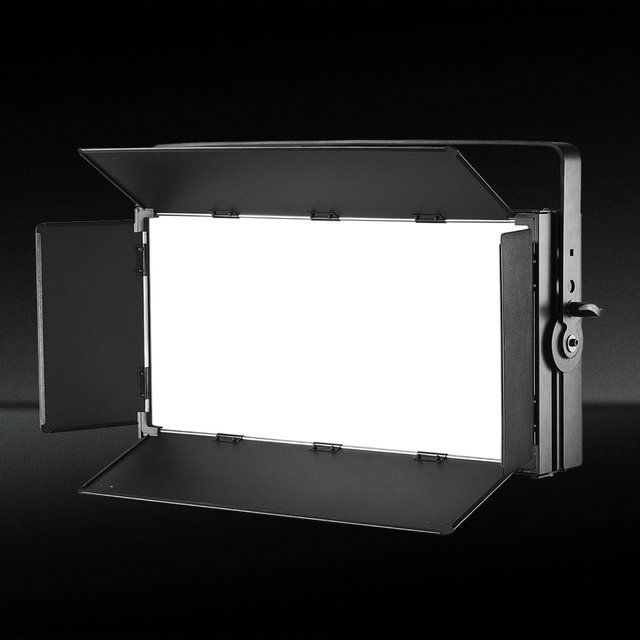
At the engineering level, a bi-color panel light relies on a highly efficient diode arrangement. The fixture houses two distinct sets of phosphor-coated emitters. One set targets warm tungsten—typically 2700K to 3200K. The other matches cool daylight around 5600K to 6500K. By intelligently modulating power between these circuits, the fixture crossfades smoothly across the Correlated Color Temperature scale.
When a gaffer is losing daylight on a fast-paced set, simplicity wins. You turn one dial for intensity and another for color temperature. You match the fading window light in seconds. This operational speed drastically accelerates the production workflow.
Because the internal power supply drives only white-light emitters, a dedicated bi-color panel yields massive photometric output. A standard 300W bi-color panel will deliver superior raw lux measurements at 5600K compared to a multi-color fixture of the exact same wattage. For setups focused on corporate interviews or daily news desks, this raw efficiency translates to lower equipment costs and faster rigging.
But these lights hit a hard wall when directors want stylistic color. Need a deep-blue rim light or a cyberpunk background wash? You have to clip physical gels to the barn doors. Gels burn out, cost money, and drastically cut your overall light output by subtracting light transmission.
Exploring the Full Color Video Light: Ultimate Creative Control
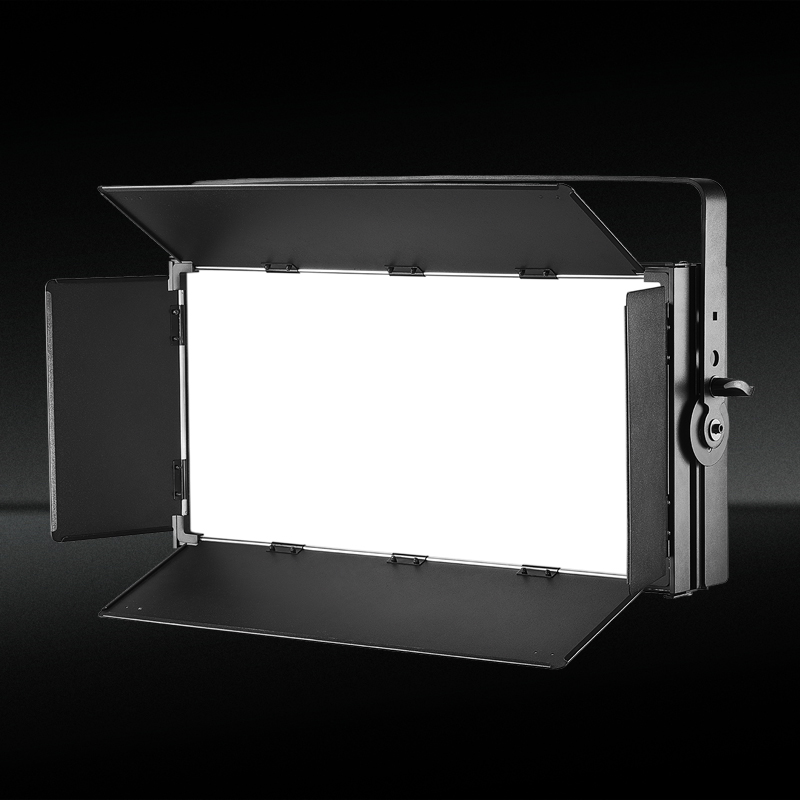
Moving beyond basic white light requires a leap in semiconductor design. A full color video light utilizes a complex matrix of colored emitters. Early models relied strictly on Red, Green, and Blue diodes. Today, sophisticated processors modulate each primary color to generate virtually any hue in the visible spectrum. Modern iterations almost always include a dedicated white diode to establish a cleaner baseline for non-colored light.
The immediate payoff is workflow speed. Lighting designers dial in exact color coordinates straight from the control board. You never touch a fragile gel sheet again. Want to emulate a specific industry-standard color filter for a music video? Digital gel libraries recall those exact parameters instantly. These units also feature programmed special effects—like police flashes or screen flicker—which are indispensable for narrative filmmaking.
Another crucial tool is the Green-to-Magenta shift control. Location shoots often involve nasty fluorescent overheads or mixed-spectrum street lamps. Dialing in a slight magenta shift corrects that green cast on the fly. This single feature saves hours of tedious post-production color grading.
Naturally, this versatility demands a steeper learning curve. The robust menu systems require a deeper understanding of color science and DMX routing. Furthermore, synthesizing white light from standard red, green, and blue chips often leaves spectral gaps, occasionally resulting in muddy or artificial-looking skin tones.
The RGBYW Soft Light Revolution: Bridging the Gap
To fix those spectral gaps, lighting engineers developed the RGBYW soft light. This advanced multi-chip architecture adds dedicated Yellow—or Amber—and White diodes into the standard matrix.
Standard color chips show a severe dip in the amber and cyan wavelengths. Those exact wavelengths are critical for rendering human skin accurately and naturally. By filling that spectral gap, this hybrid fixture produces a continuous, full-spectrum light. It delivers the exceptionally high Color Rendering Index expected from premium bi-color units, plus the infinite palette of a color-mixing system.
For modern studio managers, this architecture offers the ultimate hybrid solution. Production teams no longer have to compromise between cinematic white light and dynamic color capabilities. You get flawless skin tones and vibrant saturation in a single housing.
Full Color vs Bi-Color: Head-to-Head Technical Comparison
To assist technical directors in making an informed procurement decision, the following table breaks down the core technical differences between fixtures of equivalent wattage.
| Technical Specification | Bi-Color LED Fixtures | Full Color Multi-Chip Fixtures |
|---|---|---|
| Color Temperature Range | Typically 2700K to 6500K. | Expanded range, often 1800K to 20,000K. |
| Luminous Output | Higher raw output at native white temperatures. | Lower output for white light; power is shared across multiple color diodes. |
| Color Accuracy on Skin | Consistently high rendering scores above 95. | Advanced arrays achieve 95 plus, but older models may struggle. |
| Tint Adjustment | Rarely available on standard models. | Standard feature; essential for matching practical location lights. |
| Workflow Interface | Simple, fast interface using Dimming and Temperature dials. | Complex interface requiring Coordinate Mapping and Gel Emulation. |
| Initial Investment | Generally more budget-friendly per unit. | Higher upfront cost due to advanced processors and complex arrays. |
Photometric data consistently shows that if raw brightness for standard interview lighting is the primary requirement, a bi-color fixture offers a superior price-to-output ratio. Conversely, the ability to instantly recall specific color coordinates via a lighting console makes multi-color fixtures highly efficient for complex productions.
Essential Features Every Studio Panel Light Needs
Beyond the color engine, professional soundstages demand strict physical and operational specs. Audio clarity is a prime example. High-output LEDs generate massive heat. Active cooling fans mitigate this heat, but even low-decibel fans introduce a low-frequency hum. Sensitive shotgun microphones will inevitably catch that noise on set.
Implementing fanless video lighting is the industry standard for critical audio environments. Passive thermal management—using heavy-duty engineered aluminum heat sinks—ensures absolute silence. This eliminates expensive and time-consuming audio cleanup in post-production.
Furthermore, a professional studio panel light must integrate seamlessly into larger network ecosystems. When fixtures are permanently rigged high on a ceiling grid, manual adjustments via the back panel become impossible. Compatibility with DMX512 or Art-Net protocols allows a lighting director to control intensity, color, and effects from a centralized console.
Finally, the defining characteristic of a true soft light is its ability to wrap around a subject. This minimizes harsh shadows and reduces specular highlights on the skin. Achieving this requires a wide beam angle—typically 110 to 120 degrees—combined with high-quality internal diffusion panels.
Actionable Selection Criteria for Studio Grids
Stop guessing and look at your daily operational data. Determining the optimal lighting grid requires a systematic assessment of your content strategies and technical infrastructure.
Deploy Bi-Color Fixtures If:
Your studio output is predominantly corporate interviews, live news, or executive communications.
Raw brightness and flawless skin tones are your absolute top priorities.
Your lighting grid is fixed, and ambient color temperatures rarely shift beyond standard daylight or tungsten.
Budget constraints require maximum lux output per dollar spent.
Upgrade to Full Color Fixtures If:
You regularly shoot commercial, narrative, or music video content requiring stylized color contrast.
Your facility utilizes Virtual Production where physical lighting must pixel-map to dynamic digital backgrounds.
You operate a rental house catering to diverse, unpredictable client demands.
You want to eliminate the recurring costs and workflow delays of physical gels.
For many mid-to-large scale facilities, a hybrid approach works best. Use high-output, cost-effective bi-color panels as your primary key and fill lights. Deploy full-color fixtures for rim lights, hair lights, and background washes. This strategic allocation maximizes both your budget and your creative ceiling.
Conclusion and Next Steps
Delivering bright, budget-friendly, and highly accurate white light, bi-color fixtures remain the cornerstone for documentaries and daily broadcasts. They offer unmatched simplicity and raw output for their price point. Conversely, advanced multi-chip color models unlock endless creative possibilities, eliminating physical gels and future-proofing your space for complex virtual productions.
Your choice ultimately depends on your daily workflow and content strategy. Ready to upgrade your production space with professional-grade, silent, and color-accurate fixtures? Explore the robust lineup of premium lighting equipment at The One Studio. By matching your specific technical requirements with the right semiconductor technology, you will immediately elevate your production value and ensure pristine results on every single take.
FAQ
Is a bi-color LED soft light brighter than a full color one?
Yes. From a strictly photometric standpoint, a bi-color fixture is generally brighter than a multi-color fixture of the exact same wattage when measuring standard white light. In a 300W bi-color light, the entire 300 watts drives the white daylight or tungsten diodes. In a 300W multi-color light, the wattage splits among red, green, blue, and white chips. When set to 5600K daylight, the color light utilizes only a fraction of its total power capacity, resulting in a lower overall lux output.
What is the difference between standard RGB and an advanced multi-chip soft light?
Standard RGB technology mixes Red, Green, and Blue diodes to simulate white light. This older method often struggles to produce an accurate, full-spectrum white, frequently resulting in magenta or green color spikes that ruin skin tones. Advanced multi-chip technology incorporates dedicated Yellow and White diodes into the array. This fills in the spectral gaps, resulting in a significantly broader color gamut and vastly superior cinematic white light.
Why is fanless video lighting so important for studio production?
In a controlled studio environment, modern condenser microphones are incredibly sensitive and easily pick up ambient room noise. Active cooling fans in high-wattage lights generate a continuous hum that raises the acoustic noise floor of the room. Passively cooled lighting utilizes large aluminum heat sinks to dissipate heat without moving parts. This ensures completely silent operation, which is critical for soundstages and podcast recordings.
What is the best color temperature for studio lighting?
The ideal color temperature depends entirely on your specific environment and camera settings. For traditional broadcast newsrooms and corporate studios, 5600K is the standard choice as it perfectly matches daylight and most modern studio monitors. If you are shooting in a practical location with warm ambient lighting, such as a living room set with practical lamps, dialing your fixtures down to 3200K ensures your subject blends naturally into the background.
How many watts do I need for a studio LED light?
Wattage requirements scale with the size of your studio and the type of modifiers you use. For small podcast studios or tight interview setups, 100W to 150W fixtures provide ample key lighting. For medium-to-large commercial soundstages where lights are pushed through heavy diffusion grids or placed several meters from the talent, 300W to 600W fixtures are the baseline requirement to maintain a proper exposure at standard cinematic ISO levels.
Can I mix bi-color and full-color studio panel lights on the same set?
Yes. Mixing technologies is a highly recommended and cost-effective industry standard. A common lighting plot involves using a high-output bi-color light as the primary key light to ensure flattering illumination on the face. Simultaneously, color fixtures act as rim lights or background washers to inject depth and contrast into the frame. As long as both sets of lights feature high rendering scores, they will blend seamlessly on camera.