Why Are LED Fresnel Lights Used in Film and Television Studios?
Views: 2 Author: Site Editor Publish Time: 2026-08-06 Origin: Site


Professional film and television production relies heavily on massive power infrastructure, but aging soundstages are hitting their absolute limits. Legacy high-intensity discharge (HMI) and tungsten fixtures draw massive amperage and generate excessive heat, forcing facilities to max out their HVAC systems just to keep talent from sweating. Modern productions demand cinematic, shapeable light, yet they face strict limitations on power availability, cooling capacity, and rigging weight. Balancing these competing needs forces studio managers and lighting directors to completely rethink their grid layouts and power distribution strategies.
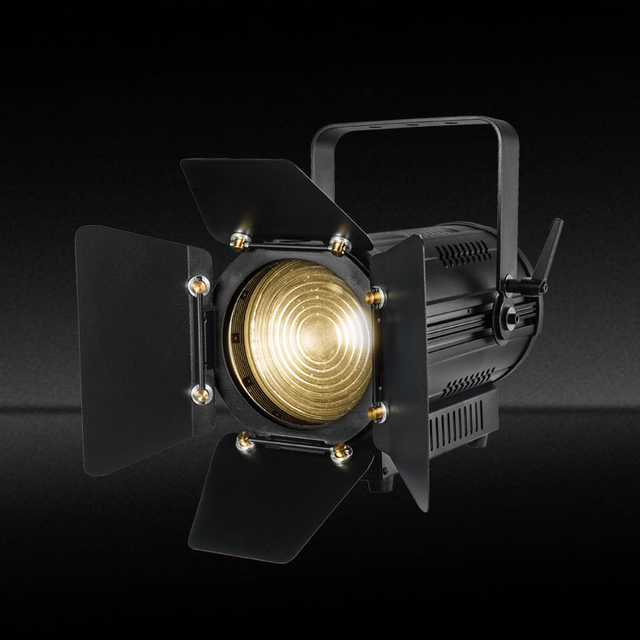
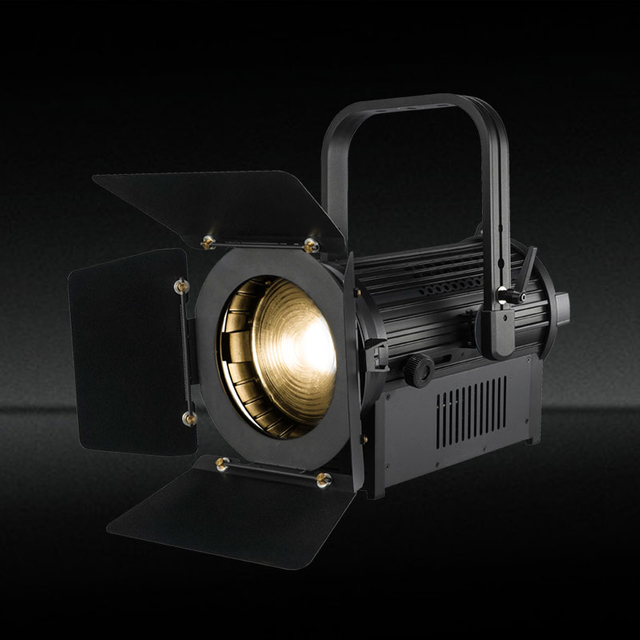
The LED Fresnel Light solves this infrastructure problem directly. It bridges traditional optical beam control with modern energy efficiency. By combining the classic stepped lens design with advanced diode technology, these fixtures deliver the precise shadow rendering cinematographers expect while drastically reducing electrical strain. This technical evaluation breaks down how the Studio LED Fresnel Light performs in professional environments, detailing its engineering, operational advantages, and implementation on the modern soundstage.
Infrastructure Efficiency: LED Fresnels drastically reduce power draw and thermal output, directly lowering facility HVAC costs and expanding the number of fixtures deployable on standard studio circuits.
Uncompromised Optical Control: The integration of modern LED engines with traditional stepped lenses maintains the essential spot-to-flood versatility and clean shadow rendering required by cinematographers.
Advanced Color Science: High-end studio LED Fresnel lights offer precise color temperature tuning and high TLCI/TM-30 scores, eliminating the color shifts commonly associated with dimming legacy tungsten fixtures.
Workflow Acceleration: Built-in DMX/CRMX capabilities allow for instantaneous, centralized control over intensity and color, significantly reducing setup times and ladder work on set.
The Engineering Behind the Studio LED Fresnel Light
How the Stepped Lens Shapes Light
The physics of the Fresnel lens rely on concentric rings that capture oblique light and focus it into a highly directional beam. Originally designed for lighthouses, this stepped structure reduces the mass and thickness of the glass compared to a standard plano-convex lens. On a soundstage, this allows the fixture to transition smoothly from a highly targeted spot for dramatic subject isolation to a soft, feathered wash of light. Cinematographers rely on this specific lens because it creates a single, clean shadow. Multi-source LED panels often create micro-shadows or stepped shadows, which look unnatural on a subject's face. The Fresnel lens homogenizes the light output, ensuring that even when using a multi-color LED engine, the resulting beam hits the subject as a unified, single-source light.
The Evolution of the Light Engine
Traditional incandescent filaments produce omnidirectional light. They throw photons in every direction, requiring large, heavy, spherical reflectors to catch that light and push the beam forward through the lens. This process is highly inefficient, with massive amounts of light and heat trapped inside the fixture housing. In contrast, modern COB (Chip on Board) LEDs are inherently directional. They emit light forward in a 120-degree spread. Manufacturers engineer internal reflectors specifically for these flat diode arrays to maximize output directly through the lens. This direct emission path increases optical efficiency and allows for a much more compact fixture design. You get the punch of a much larger light in a housing that takes up half the space on the grid.
Active vs. Passive Cooling and Ventilation Mechanisms
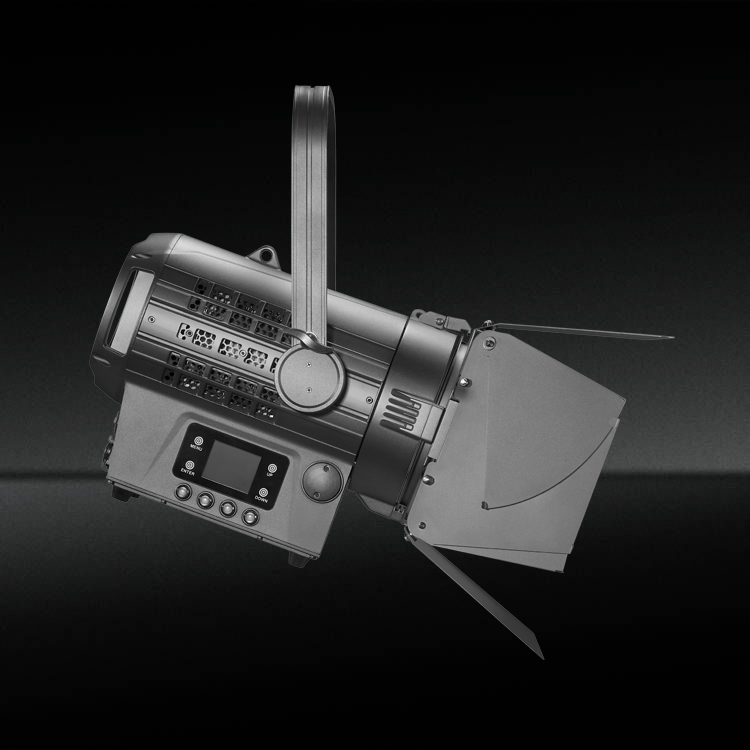
Managing the heat generated at the LED diode level dictates the lifespan and color accuracy of the fixture. If a COB gets too hot, the color temperature shifts and the output drops. Manufacturers utilize physical chassis ventilation designs that prevent heat buildup while keeping dust and moisture out. Internal heat sinks draw thermal energy away from the COB, while low-decibel fans actively expel it into the ambient air.
| Cooling Mechanism | Application | Acoustic Impact | Thermal Efficiency |
|---|---|---|---|
| Passive Cooling (Heatsink Only) | Low-wattage fixtures, location shoots | Completely silent (0 dB) | Low to Moderate |
| Active Cooling (Standard Fan) | High-output studio fixtures | Noticeable (30+ dB) | High |
| Smart Active Cooling (Variable Fan) | Professional soundstages | Ultra-low (under 20 dB) | Maximum |
| Liquid Cooling | Extreme output (1000W+ LEDs) | Low pump noise | Extreme |
These quiet fans are non-negotiable for soundstage environments. The sound department requires a pristine audio floor to capture clean dialogue. Modern fixtures use variable-speed fans tied to thermal sensors, ensuring the fan only spins as fast as necessary to maintain safe operating temperatures.
Core Success Criteria for Studio Lighting Upgrades
Power Draw and Infrastructure Limitations
Calculating power-to-output ratios dictates how you design a lighting grid. A traditional 2K tungsten fixture draws roughly 16.6 amps on a standard 120V circuit. If you have a 20-amp circuit, you can only plug in one of those lights. An equivalent LED fixture draws a fraction of that amperage, often operating under 4 amps while delivering the same photometrics. This massive reduction in power draw allows studios to deploy significantly more fixtures on existing electrical infrastructure. You eliminate the need for heavy 4/0 cable runs, massive distribution boxes, and expensive tow-behind generator rentals.
Audit the current amperage capacity of the studio grid.
Calculate the total draw of the proposed LED lighting package.
Identify circuits that can be combined or repurposed.
Map out the new DMX distribution network alongside the power runs.
Test the system under full load to ensure breaker stability.
Thermal Management and HVAC Load Reduction
Replacing tungsten units with LEDs drastically reduces ambient heat on set. A 2K tungsten light converts about 90% of its energy into heat and only 10% into visible light. When you have twenty of these on a grid, you are essentially running a massive space heater. This reduction goes far beyond talent comfort. Lower thermal output means the facility HVAC system works significantly less. You stop fighting the lights with the air conditioning. This also reduces acoustic interference from massive AC units kicking on during quiet takes.
Acoustic Requirements for Soundstages
Dialogue-heavy television and film environments require strict acoustic control. Lighting fixtures must operate below acceptable noise floors, typically under 20 to 25 decibels at a one-meter distance. High-quality fixtures utilize advanced fan control algorithms to maintain these low noise levels. If a light ramps up its fan during a long take, it ruins the audio. Gaffers specifically look for fixtures that offer a "silent mode," which caps the maximum output of the light to ensure the fan never exceeds a specific RPM.
Evaluating LED Fresnel Light Performance Metrics
Color Accuracy and Spectrum Rendering
Basic CRI (Color Rendering Index) is an outdated metric for evaluating professional lighting. It only tests a few color swatches and ignores the complex spectral response of modern digital cinema cameras. Evaluators must look at TLCI (Television Lighting Consistency Index), SSI (Spectral Similarity Index), and TM-30 data. TLCI specifically measures how a light will render on a broadcast camera. SSI compares the light's spectrum directly to a perfect standard, like daylight or a tungsten bulb. TM-30 provides a detailed vector graphic showing exactly which colors are oversaturated or undersaturated.
| Metric | What It Measures | Ideal Score for Studio Use |
|---|---|---|
| CRI (Ra) | General color rendering based on 8 swatches | 95+ |
| TLCI | Color rendering specifically for broadcast cameras | 96+ |
| SSI (Tungsten) | Spectral match to a perfect tungsten source | 85+ |
| TM-30 Rf | Fidelity (accuracy of 99 color samples) | 93+ |
| TM-30 Rg | Gamut (saturation of colors) | 100 to 103 |
These advanced metrics ensure accurate skin tone reproduction. If a light has a low SSI score, it might look fine to the naked eye, but the camera sensor will pick up nasty green or magenta spikes that require heavy color correction in post-production.
Dimming Curves and Color Shift Mitigation
Smooth low-end transitions require 16-bit dimming capabilities. Standard 8-bit dimming only provides 256 steps of brightness, which causes visible stepping or flickering when fading a light down to zero. 16-bit dimming provides over 65,000 steps, allowing for perfectly smooth theatrical fades. Unlike tungsten fixtures, which physically cool down and shift orange as you lower the voltage, an LED maintains a consistent color temperature across its entire dimming range. You can dim the light from 100% to 1% without the color shifting. This stability eliminates the need to add corrective gels when you just want to lower the intensity.
Beam Angle Versatility (Spot-to-Flood Ratios)
The utility of a Fresnel lies entirely in its beam angle versatility. Acceptable ranges typically span from a tight 15-degree spot to a wide 60-degree flood. This ratio determines how effectively the fixture functions across different setups. When spotted in, it acts as a sharp key light or a hard backlight that cuts through ambient fill. When flooded out, it provides a broad, even wash over a set piece or a green screen. The internal sled mechanism moves the COB closer to or further from the lens, changing the beam angle mechanically without altering the color output.
Operational Advantages in Film and Television Studios
DMX, CRMX, and Console Integration
Integrating a fixture into complex lighting grids requires robust control protocols. Wired DMX (via 5-pin XLR) and wireless CRMX (like LumenRadio) are the backbone of automated studio setups. These protocols allow lighting programmers to adjust intensity, color temperature, green/magenta shift, and even motorized beam angles remotely from a centralized console. You no longer need to send a technician up a ladder to adjust a dimmer or swap a gel. Everything happens instantly from the lighting desk.
Integration with Virtual Production (ICVFX) and LED Volumes
These fixtures play a critical role on virtual stages. LED video walls alone cannot light talent realistically. The panels lack the full color spectrum and directional punch needed to create convincing shadows. If you only use the video wall to light the actors, they look flat and muddy. The precise beam control of a lensed fixture prevents unwanted light spill onto the LED volume, which would wash out the background image. You use the lensed fixture to match the direction and color of the virtual sun or streetlights, seamlessly blending the physical actors into the digital environment.
Rigging, Weight, and Grid Management
Physical footprint dictates how you manage motorized truss systems and pipe grids. While some high-output units require external power supplies or ballasts, their overall weight often remains highly competitive with legacy fixtures. The real weight savings come from the infrastructure. You eliminate heavy dimmer racks, massive socapex cables, and heavy-duty distribution boxes.
Verify the weight capacity of the studio pipe grid or motorized truss.
Account for the weight of the fixture, barndoors, and any external power supplies.
Use rated safety cables for every fixture and accessory.
Balance the weight distribution evenly across the truss to prevent motor strain.
Ensure all wireless DMX antennas have a clear line of sight to the transmitter.
Dress all power and data cables neatly to prevent snagging during truss movement.
On-Set Workflow Speed and Safety
Solid-state lighting accelerates on-set workflows dramatically. Eliminating hot scrims, heavy dimmer racks, and frequent bulb replacements translates to faster company moves. When the director asks for a color change, the lighting board operator executes it in seconds, rather than waiting for a grip to climb a ladder and clip on a piece of gel. It also reduces liability for the grip and electric departments by minimizing burn hazards. Legacy lights get hot enough to cause severe burns instantly; modern fixtures remain cool enough to touch even after hours of operation.
Implementation Risks and Mitigation Strategies
Mixing LEDs with Legacy Fixtures
Integrating new fixtures into a grid that still utilizes older tungsten or fluorescent units introduces the immediate risk of spectrum mismatch. Even if you set the new light to 3200K to match a tungsten bulb, the spectral output is different. The camera will see the difference, usually manifesting as a green or magenta shift on skin tones. We recommend testing the combined lighting setup with a spectrometer (like a Sekonic C-800) to identify and correct any shifts before shooting begins. You can dial in a slight minus-green adjustment on the new fixture to perfectly match the legacy lights.
Evaluating Build Quality, Portability, and Weatherproofing
Studios operating hybrid workflows that bounce between the soundstage and location shooting must evaluate build quality ruthlessly. Assess IP ratings for weatherproofing. An IP20 rating is fine for a climate-controlled studio, but if the light goes outside, you need IP54 or IP65 to survive rain and dust. Compare housing materials. Impact-resistant thermoplastics save weight, but milled aluminum and steel yokes ensure structural durability during transport and heavy-duty location rigging. A broken yoke renders the light useless, regardless of how good the color science is.
Firmware Updates and Ecosystem Lock-in
Proprietary control ecosystems limit future flexibility. If a manufacturer forces you to use their specific app or wireless protocol, you cannot easily integrate lights from other brands. Prioritize fixtures that support industry-standard protocols like Art-Net, sACN, and standard CRMX. Ensure the manufacturer offers straightforward, user-accessible firmware update paths via USB or Bluetooth. As lighting consoles evolve and new color spaces are introduced, your fixtures need firmware updates to remain compatible.
Conclusion
The transition to solid-state lensed fixtures is a necessary operational upgrade for modern production efficiency. These units provide the exact optical control of legacy units while solving critical power, heat, and workflow bottlenecks on the soundstage. You get the cinematic shadows you need without melting the talent or tripping the breakers.
Rent a shortlist of fixtures and conduct a dedicated camera test with your specific digital cinema sensors.
Consult with a specialized lighting integrator to map out your DMX/CRMX control protocols and network architecture.
Conduct a facility power audit to quantify the exact amperage reduction your studio will achieve.
Standardize your mounting hardware and safety cabling protocols before installation.
FAQ
Q: What is the LED equivalent of a 1K or 2K tungsten Fresnel?
A: A 150W to 200W solid-state fixture typically matches the output of a 1K tungsten fixture. A 300W to 400W unit generally provides the equivalent output of a 2K tungsten unit, depending heavily on the manufacturer's specific optical efficiency and reflector design.
Q: Do LED Fresnel lights produce hard or soft light?
A: They produce a directional, semi-hard light. The stepped lens creates crisp, defined shadows when spotted in, but the beam edge is softer and more feathered than a standard ellipsoidal reflector spotlight, making it highly flattering for talent.
Q: Can you use traditional modifiers on an LED Fresnel?
A: Yes. Most professional units feature standard accessory slots for barndoors, snoots, and scrims. Because they emit very little forward heat, you can safely use standard lighting gels and diffusion without them melting or burning through.
Q: Why are LED Fresnels more expensive than LED panels?
A: They require complex glass optics, motorized or manual focusing sled mechanisms, and highly concentrated COB light engines with advanced active cooling systems. This precision engineering increases manufacturing costs significantly compared to simple flat panels.
Q: How does the lifespan of an LED Fresnel compare to an HMI fixture?
A: The COB engine typically lasts 50,000 hours or more with minimal color shift. HMI bulbs usually require replacement every 500 to 1,000 hours and degrade in color temperature and output rapidly over their short lifespan.
Q: Do LED Fresnel lights flicker when shooting at high frame rates?
A: Professional units use high-frequency PWM (Pulse Width Modulation) dimming to ensure flicker-free operation. You can shoot at extremely high frame rates for slow-motion capture without seeing banding or flickering in the footage.
Q: Can a studio LED Fresnel light be used as a wash light?
A: Yes. By adjusting the internal mechanism to the maximum flood position, the fixture spreads the beam widely. This creates a smooth, even wash of light over a large area, perfect for lighting backdrops or green screens.