What Is the Difference Between LED Fresnel Lights and LED Panel Lights?
Views: 1 Author: Site Editor Publish Time: 2026-08-08 Origin: Site


While the transition to LED technology has standardized energy efficiency and color accuracy across the industry, the optical physics and beam characteristics of different fixture types remain fundamentally distinct. A diode is simply a light source. How you shape, direct, and control that light dictates its utility on set. Misaligning lighting fixtures with production requirements results in wasted setup time, excessive spending on corrective modifiers, and compromised visual aesthetics. Trying to force a broad light source to act like a precision spotlight requires heavy flagging and negative fill. Attempting to soften a hard point source without the proper diffusion frames leads to harsh, unflattering shadows. These inefficiencies drain resources during critical production windows. This technical comparison between an LED Fresnel Light and an LED panel light helps gaffers, cinematographers, and studio managers make evidence-based procurement decisions. By evaluating mechanics, photometric performance, and operational realities, production teams can build versatile, efficient lighting packages tailored to specific workflows.
Beam Control: An LED Fresnel light utilizes a focusing lens system to maximize light power and control beam angles, whereas an LED panel provides a fixed, broad wash of light.
Light Quality: Fresnels act as point sources, producing hard, directional light with natural falloff and a feathered edge; panels act as broad sources, generating inherently softer light with rapid falloff.
Workflow Efficiency: LED panels offer faster deployment in run-and-gun scenarios, while Fresnels require more deliberate rigging but offer superior versatility through precise modification.
Investment Strategy: The choice dictates the required supporting grip equipment—Fresnels demand heavier stands and specific modifiers, while panels require less infrastructure but offer less beam manipulation.
Understanding the Core Technologies
The Mechanics of an LED Fresnel Light
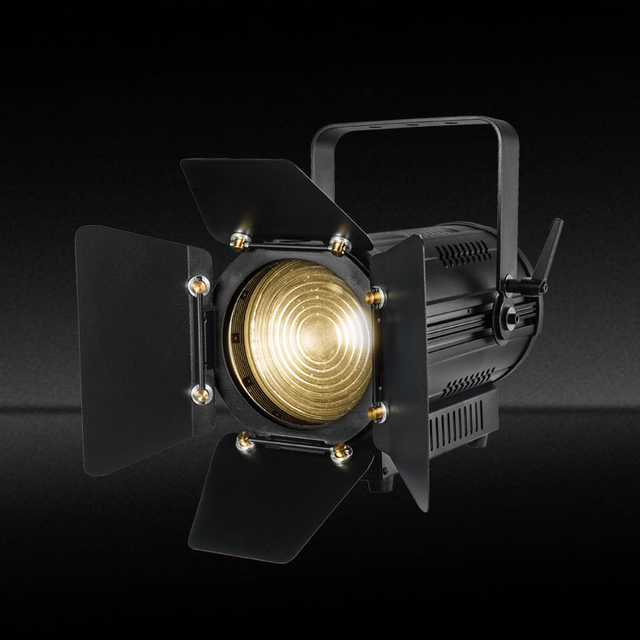
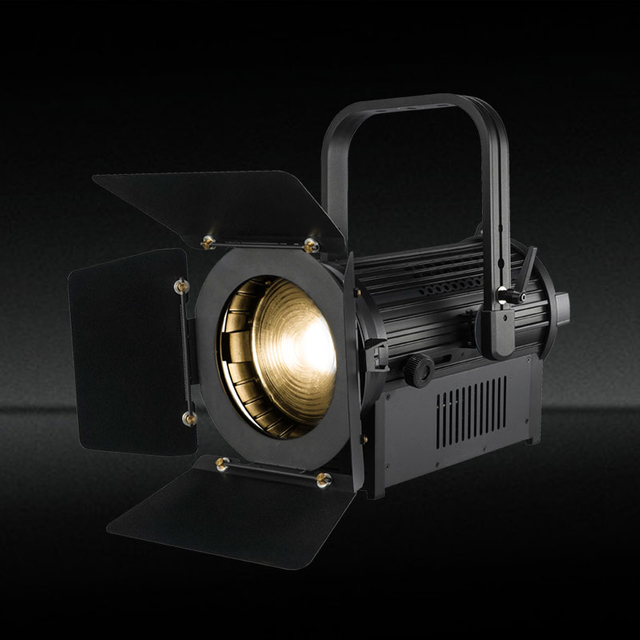
The architecture of a modern Fresnel fixture centers on a single high-output COB (Chip on Board) LED paired with a stepped glass or acrylic lens and an internal reflector. The stepped design of the lens allows it to remain relatively thin and lightweight while still providing the optical properties of a much thicker plano-convex lens. This combination gathers the raw output of the diode and directs it forward in a controlled beam. You get a highly efficient optical path that maximizes the punch of the fixture.
The defining feature of this fixture is the spot-to-flood mechanism. By moving the COB diode closer to or further from the lens via an internal sled, you concentrate the light power into a tight spot or widen it into a broad flood. This mechanical adjustment physically alters the beam angle. A single fixture serves multiple roles on set, from a tight hair light to a broad background wash. The internal mechanics require precise engineering to ensure the diode remains perfectly aligned with the optical center of the lens throughout its travel.
Compared to traditional tungsten Fresnel fixtures, the modern LED equivalent offers a drastic reduction in power consumption and eliminates extreme heat generation. Tungsten bulbs convert a massive amount of energy into infrared heat. They require heavy leather gloves for operation and constant ambient cooling on sound stages. LED diodes run significantly cooler and boast an extended lifespan. You often get over 50,000 hours of operation without needing bulb replacements. This shift fundamentally changes how grip trucks are packed and how studio power distribution is calculated.
The Mechanics of an LED Panel Light
An LED panel relies on a completely different architectural approach. Instead of a single powerful diode, a panel features a flat array of hundreds of smaller surface-mounted diodes (SMD). These diodes spread across a rectangular or square circuit board. Manufacturers often cover them with a built-in diffusion panel or a remote phosphor layer to blend the individual light points into a single source.
The physics of multi-diode arrays directly impact shadow edge transfer. Because the light originates from multiple points across a broad surface area, it creates a less defined source. The light wraps around subjects, inherently producing softer shadows. However, if the diffusion layer is inadequate, each individual diode casts its own micro-shadow. This results in a stepped or multi-layered shadow edge that looks unnatural and visually distracting on camera. High-quality panels use advanced diffusion materials to mitigate this effect, but the broad nature of the source remains constant.
Distinguishing Point Source LEDs from True Fresnel Fixtures
You must differentiate between standard open-face COB monolights equipped with reflector dishes and integrated Fresnel fixtures featuring built-in optical focusing lenses. A bare COB light with a Bowens-mount reflector acts as a point source but lacks precise beam control. The reflector simply catches spill and pushes it forward. This often results in a hot spot in the center and uneven light distribution across the field. It is a brute-force method of directing light.
The optical path of a true Fresnel produces a cleaner, more uniform field of light. The internal reflector and the stepped lens work in tandem to collimate the light rays. This produces a beam that is smooth from edge to edge. It becomes highly predictable when cutting with barn doors or blending with other fixtures on a stage. You do not get the messy spill or the harsh center hot spot associated with basic reflector bowls.
Evaluation Dimensions: Performance and Output Characteristics
Beam Shaping and Throw Distance
The long-throw capabilities of a Fresnel fixture are unmatched by standard panels. Because the lens collimates the light rays, a Fresnel maintains its intensity over significant distances. You can place the fixture far away from the talent—perhaps on a high grid or outside a window—and still deliver a powerful, punchy key light. In contrast, an LED panel scatters light over a wide area. The intensity drops off rapidly over distance, making panels ineffective for long-throw applications.
Precision in cutting light is another major differentiator. Barn doors on a Fresnel create sharp, defined cuts because the light rays travel in a relatively parallel direction. You can precisely shape the beam to highlight a specific area or keep light off a background wall. Barn doors on a panel only reduce spill. Because the light source is broad, the barn doors cannot create hard lines. They merely create a soft, graduated shadow that is difficult to control precisely.
A unique characteristic of the Fresnel beam is its feathered edge. Unlike the hard, sharp edge of an ellipsoidal or Leko fixture, a Fresnel beam gradually tapers off at the edges. This feathered quality allows multiple lights to blend seamlessly across a stage. You create an even wash without visible overlapping lines. This is why Fresnels remain the standard for theatrical and live event lighting.
Light Quality and Shadow Falloff
The aesthetic differences in Professional Studio Lighting often come down to the wrap of a panel versus the contrast and punch of a Fresnel. Panels provide a flattering, wrapping light that fills in imperfections and creates a low-contrast look. This is ideal for beauty commercials or corporate interviews. Fresnels deliver high contrast, emphasizing texture and shape. This is essential for dramatic narrative cinematography where mood and depth are required.
The concept of natural falloff is governed by the inverse-square law. While both point sources and broad sources obey this law, the practical application differs on set. A focused point source like a Fresnel can be placed further away. The distance between the light, the subject, and the background is greater. This results in a more gradual falloff of light across the scene. A panel must be placed closer to the subject to maintain intensity. This results in rapid falloff, causing backgrounds to go dark quickly.
Photometric Efficiency and Power Utilization
Fresnels capture and direct a higher percentage of the diode's raw output toward the subject via their reflection and focusing system. When spotted in, the lux output at the center of the beam increases dramatically. This optical efficiency means you achieve higher light levels on your target without necessarily increasing the wattage of the fixture. You get more usable light per watt consumed.
Contrast this with the inherent light loss of panels. Because panels scatter light over a wider, uncontrolled area, much of the output misses the subject entirely. To match the targeted lux of a focused Fresnel at a distance, a panel requires significantly higher wattage and a much larger surface area. This reduces overall power efficiency and increases the physical footprint of the lighting setup.
Operational Realities in Professional Studio Lighting
Setup Speed and Spatial Footprint
LED panels offer distinct workflow advantages for fast-paced location work. Their slim profiles and lightweight construction make them easy to transport and quick to deploy. A panel can be pulled from a case, mounted on a lightweight stand, and powered on in minutes. This speed is invaluable in run-and-gun documentary shooting or news gathering where time is limited.
Fresnels require a larger spatial footprint and more robust support. The deeper fixture bodies and heavier weight demand sturdy C-stands or combo stands. Furthermore, achieving soft light with a Fresnel requires external diffusion frames, such as 4x4 silks or large softboxes. These take additional time to build and require more floor space. You also need sandbags to secure the heavier, top-heavy rigs.
For live staging and events, the physical zoom controls of a Fresnel provide unmatched adaptability. As staging layouts change or speakers move across a platform, lighting technicians quickly adjust the spot-to-flood ratio. You do this without physically re-rigging or moving the fixture. This remote or pole-operated adjustability saves hours during complex stage setups.
Modifier Ecosystems and Compatibility
The modifier ecosystems for these two fixture types reflect their distinct optical properties. Understanding what fits on the front of your light is just as important as the light itself.
| Modifier Type | Fresnel Compatibility & Use Case | Panel Compatibility & Use Case |
|---|---|---|
| Barn Doors | Standard. Creates precise, sharp cuts to shape the beam and control spill. | Limited. Only controls spill; cannot create sharp cuts due to the broad source. |
| Softboxes / Diffusion | Requires heavy-duty speed rings. Transforms the hard point source into a soft, wrapping light. | Standard. Snap grids and light diffusion fabrics enhance the inherently soft output. |
| Snoots / Irises | Highly effective. Isolates light to a very specific, small area (e.g., a tight hair light). | Incompatible. The broad surface area cannot be effectively funneled through a snoot. |
| Gels | Easily clipped to barn doors. High output pushes through heavy color gels effectively. | Can be clipped, but modern RGBWW panels often eliminate the need for physical gels. |
Thermal Management and Acoustic Profiles
High-output Fresnels generate concentrated heat at the COB diode, requiring active cooling systems. Internal heat sinks paired with cooling fans are standard. While modern fans are designed to be quiet, the acoustic profile must be considered when placing fixtures close to microphones in quiet studio environments. You must check the decibel rating of the fans before deploying them on a soundstage.
LED panels distribute their heat across a wide array of smaller diodes. They often rely entirely on passive cooling. The aluminum chassis acts as a large heat sink, eliminating the need for fans. This zero-noise operation makes panels highly desirable for intimate interview setups or sound-critical recording spaces where any background hum ruins the audio take.
Cost-to-Value and Scalability Factors
Initial Investment vs. Lifecycle Versatility
When evaluating the initial investment, frame the Fresnel as a multi-tool and the panel as a specialized tool. A Fresnel can be used as a hard, punchy light, or it can be pushed through diffusion to act as a soft light. This versatility allows it to serve as a key, fill, or backlight depending on the modifier used. An LED panel is inherently soft and cannot be modified to produce a hard, directional beam.
Hidden costs must be factored into the procurement strategy. While a panel might seem complete out of the box, a Fresnel requires a budget for necessary modifiers. You need barn doors, speed rings, softboxes, and heavier grip gear to unlock its full potential. However, the lifecycle versatility of the Fresnel often justifies the higher initial grip investment because you rent fewer specialized lights for different setups.
Scaling for Studio vs. Location Work
Power draw and battery operation dictate scalability for remote productions. Many modern LED panels and lower-wattage Fresnels support V-mount or Gold mount battery operation. This allows for untethered shooting in remote locations. However, high-output Fresnels typically require mains power or heavy-duty block batteries. This complicates remote logistics and requires a dedicated generator.
Transporting multiple panels is generally easier due to their flat form factor. You can fit several units into a single rolling case. Transporting multiple Fresnels requires larger, padded cases to protect the lenses and deeper fixture bodies. This increases the cargo footprint for location work and requires larger grip trucks.
Implementation Risks and Mitigation
Common Misapplications on Set
A frequent risk on set is relying on LED panels for key lighting in large spaces. Because panels lack throw distance, attempting to light a wide shot with a panel often results in flat, uncontrolled illumination. You get inadequate exposure on the primary subjects. The light spills everywhere, destroying contrast and washing out the background.
Deploying bare Fresnels for interview lighting without adequate diffusion is another common error. The hard point source causes harsh, unflattering shadows across the face. It causes severe talent discomfort due to the intense glare. Proper diffusion or bouncing the light into a beadboard is mandatory in these scenarios to protect the talent's eyes and improve the aesthetic.
Mitigating Color Shift and Flicker
Evaluating color accuracy is mandatory for any lighting package. Rely on metrics like CRI (Color Rendering Index), TLCI (Television Lighting Consistency Index), and SSI (Spectral Similarity Index). These ensure skin tones render naturally and colors match across different light sources. Mixing fixtures with poor color metrics requires extensive post-production correction and grading time.
Flicker is a severe risk when shooting at high frame rates or fast shutter speeds. You must check the PWM (Pulse Width Modulation) frequencies of both panels and Fresnels. Professional fixtures utilize high-frequency PWM to ensure flicker-free operation. Budget fixtures may exhibit banding or strobing under specific camera settings, ruining the footage entirely.
Conclusion
LED Fresnels deliver control, punch, and versatility, offering the ability to shape light precisely and maintain intensity over distance. LED panels excel in speed, space efficiency, and providing immediate, flattering soft light with minimal setup. Understanding these inherent physical differences prevents costly delays and compromised visuals on set. Choose Fresnels for narrative filmmaking, live event staging, and highly controlled studio environments where lights must blend seamlessly and be precisely cut. Choose panels for run-and-gun documentaries, tight corporate spaces, and quick-turnaround broadcast setups where speed and footprint are the primary constraints.
To optimize your lighting package, take the following steps:
Conduct a comprehensive lighting audit of your current grip equipment to identify gaps in hard or soft light capabilities.
Rent shortlisted fixtures for a camera test to evaluate their color accuracy and shadow rendering with your specific camera sensors.
Evaluate the specific power constraints and spatial limitations of your primary shooting locations before committing to high-draw or large-footprint fixtures.
Standardize your battery mounts (V-mount or Gold mount) across all portable fixtures to streamline charging logistics.
FAQ
Q: Can an LED Fresnel light be used as a soft light?
A: Yes, by bouncing it off a reflector or pushing it through diffusion materials like a silk or softbox, though it requires more space and grip gear than a panel.
Q: Why do LED panels create multiple shadows?
A: Because they are made of hundreds of individual diodes; if the diffusion layer is inadequate, each diode casts its own micro-shadow, creating a stepped shadow edge.
Q: Which light is better for a green screen setup?
A: LED panels are generally preferred for lighting the screen itself due to their broad, even wash, while Fresnels are better for lighting the subject to separate them from the background.
Q: Do LED Fresnel lights get hot like traditional tungsten lights?
A: No, they operate at significantly lower temperatures than tungsten or HMI fixtures, though the COB chip does generate heat that requires internal heat sinks or fans.
Q: How does an LED Fresnel light compare to a legacy tungsten Fresnel in power consumption?
A: LED Fresnels consume up to 80% less power for equivalent output and feature a lifespan of 50,000+ hours, compared to the 100-200 hour lifespan of traditional tungsten bulbs.
Q: What is the difference between an LED Fresnel and an ellipsoidal spotlight?
A: An ellipsoidal spotlight produces an extremely sharp, defined beam of light with internal shutters for precise hard-edged cuts, whereas a Fresnel produces a feathered, soft-edged beam.
Q: Can I run professional studio lighting on battery power?
A: Yes, many modern LED panels and lower-wattage LED Fresnels can be powered by V-mount or Gold mount batteries, but high-output Fresnels typically require mains power.