What Is an LED Fresnel Light and How Does It Work?
Views: 3 Author: Site Editor Publish Time: 2026-08-06 Origin: Site


The professional lighting industry has largely transitioned from traditional tungsten and HMI fixtures to advanced solid-state technology. Film sets, broadcast television studios, and theatrical stages rely heavily on modern fixtures to meet rigorous production demands. Lighting directors, gaffers, and AV integrators face a specific challenge during this transition: replicating the classic, highly controllable, soft-edged beam of a traditional fixture while meeting modern demands for lower power consumption, reduced heat generation, and advanced color control. Selecting the right fixture requires understanding the underlying optics, the specific advantages of solid-state engines, and the technical criteria that separate consumer-grade lights from professional-grade investments. A true LED Fresnel Light delivers precision, consistency, and durability on set. Evaluating these fixtures means looking beyond basic output and examining color accuracy, beam mechanics, and thermal management.
Key Takeaways
Optical Mechanics: An LED Fresnel light utilizes a stepped, concentric-ring lens paired with a movable LED engine to deliver a highly controllable, soft-edged beam with adjustable spot-to-flood capabilities.
Single-Source Advantage: Unlike multi-emitter LED panels, an LED Fresnel spotlight acts as a single-source point light, casting clean, single shadows and allowing precise cutting with barn doors.
Operational Efficiency: Modern LED Fresnels reduce power consumption by up to 80% compared to tungsten equivalents, while virtually eliminating the ambient heat that complicates studio HVAC management.
Application Versatility: From film sets and broadcast studios to live theater, the LED Fresnel fills the gap between hard profile spots and ultra-wide soft panels.
Evaluation Criteria: Purchasing decisions must prioritize color accuracy metrics (CRI/TLCI/TM-30), acoustic noise (cooling fan decibel levels), and optical clarity (absence of color fringing at the beam edge).
What Is an LED Fresnel Light and How Does It Work?
The baseline expectation for any Fresnel fixture is its ability to deliver a directional, single-source light with a smooth fall-off that wraps naturally around subjects. It must cut cleanly with barn doors without producing multiple overlapping shadows. Achieving this requires a precise combination of specialized optics and a unified light source. When rigging a grid or setting up a floor stand, technicians expect the beam to behave predictably, allowing for rapid adjustments during tight production schedules.
The Anatomy of the Fresnel Lens
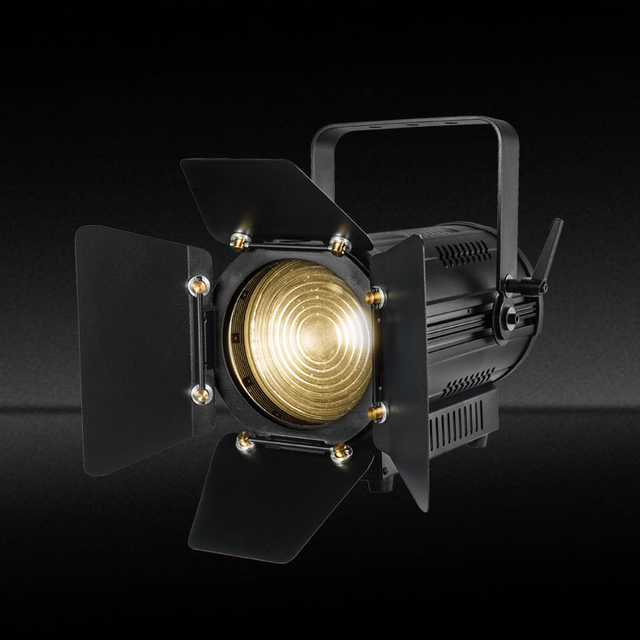
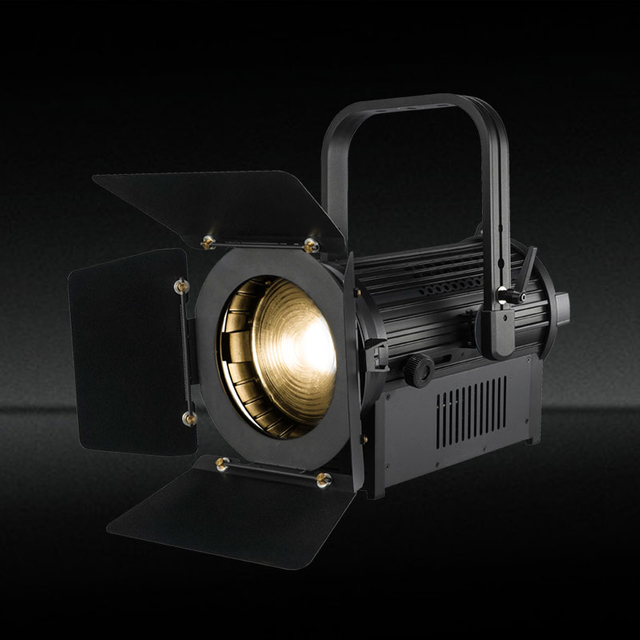
The defining feature of this fixture is its stepped, concentric-ring lens. Originally designed for lighthouses, this geometry reduces the overall weight and thickness of the glass while retaining the light-gathering and focusing properties of a standard plano-convex lens. Instead of a thick, heavy block of glass, the lens features a carved surface that bends light rays into a parallel beam. This design minimizes light loss through absorption, maximizing the output efficiency of the fixture.
Manufacturers typically use either glass or polycarbonate for these lenses. Glass lenses offer superior optical clarity and high heat resistance, making them the standard for high-output professional fixtures. They do add significant weight to the fixture head, requiring heavier C-stands or robust grid pipe rigging. Lightweight polycarbonate or acrylic lenses provide impact resistance and reduce the rigging load. These synthetic lenses are easier to handle on fast-paced location shoots but are more susceptible to scratching and long-term degradation from intense light engines. Dust and debris can settle in the concentric rings, requiring regular maintenance with compressed air and specialized optical cleaning solutions to prevent beam distortion.
The Single-Source Optical Engine
Traditional fixtures relied on omnidirectional incandescent bulbs. Modern equivalents utilize directional Chip-on-Board (COB) LED arrays. A COB engine packs hundreds of microscopic light-emitting diodes into a single, dense cluster covered by a unified phosphor layer. This dense arrangement mimics a traditional single-filament bulb, projecting light forward in a unified beam rather than scattering it in all directions.
Operating as a true point source prevents the ugly multi-shadow artifacts common in older multi-diode panel designs. When you place a flag or barn door in front of a COB-driven fixture, you get a single, distinct shadow line. This characteristic is mandatory for precise cinematic lighting, where gaffers need to shape the light to avoid spilling onto background walls or other actors. The unified phosphor layer also ensures color consistency across the entire beam field, preventing the magenta or green fringing that plagues inferior LED arrays.
The Spot-to-Flood Mechanism
The versatility of the fixture comes from its internal carriage system. The lens remains stationary at the front of the housing while the LED engine moves along an internal track. Moving the engine closer to the lens creates a wide, dispersed "flood" beam, ideal for washing large areas or providing a soft key light through diffusion. Moving it further away concentrates the light rays into a narrow, intense "spot" beam, perfect for isolating subjects or simulating sunlight punching through a window.
Adjusting this carriage happens in two primary ways. Standard studio fixtures use manual worm-gear mechanisms operated via a rotary knob on the back of the housing. This mechanical linkage must be smooth and free of backlash to allow for precise beam sizing. For high-altitude rigging or automated studio grids, motorized versions feature DMX-controlled focus adjustments. This allows board operators to change beam angles remotely from the lighting console, saving hours of labor that would otherwise require a technician on a scissor lift or ladder.
Thermal Management and Heat Dissipation
High-output COB engines generate intense localized heat at the diode junction. If this thermal load is not managed, the diodes will shift in color temperature, lose output efficiency, and degrade rapidly. Professional fixtures incorporate internal copper heat pipes that draw heat away from the COB array into massive aluminum heat sinks. These heat sinks feature extensive fin arrays to maximize surface area for thermal transfer.
Active cooling systems, utilizing ultra-quiet fans, then expel the heat from the housing. The acoustic design of these fans is critical. They must move enough air to protect the electronics while remaining completely inaudible to sensitive studio microphones. Many high-end units feature variable fan speeds controlled by internal thermal sensors, or specific "silent modes" that cap the maximum light output to allow for passive cooling during critical audio takes.
LED Fresnel Spotlight vs. Traditional Tungsten: Analyzing the Trade-offs
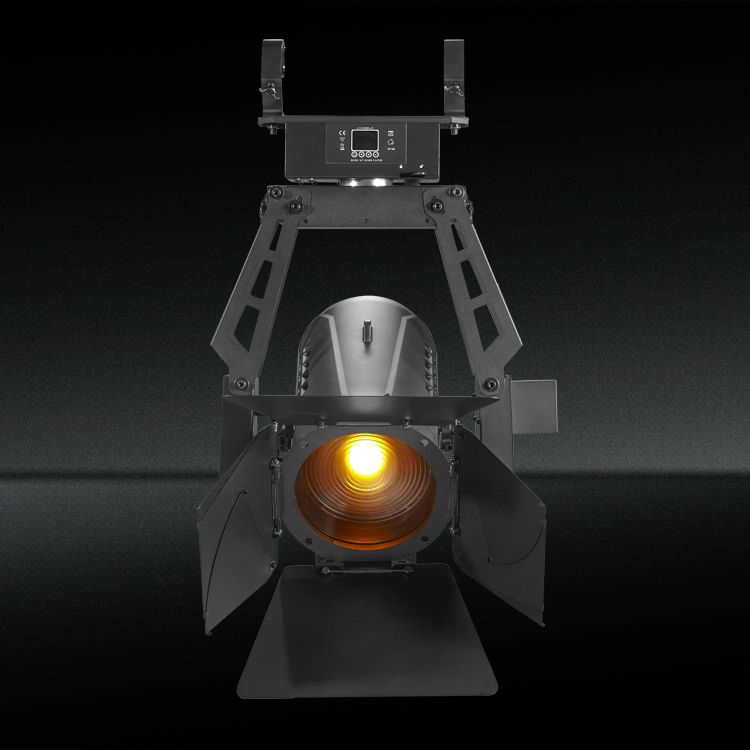
Switching from legacy incandescent fixtures to a modern LED Fresnel Spotlight fundamentally changes the operational realities of a production space. The differences extend far beyond the initial purchase, impacting daily workflow, infrastructure requirements, and on-set comfort. Crews must adapt their rigging practices and power distribution strategies to maximize the benefits of solid-state technology.
Power Draw and Infrastructure
Traditional tungsten units pull massive amounts of electricity. A standard 1K (1000-watt) tungsten fixture draws over 8 amps on a 120V circuit. Rigging multiple units requires heavy-duty power distribution, specialized cabling (such as 4/0 feeder cable), and often dedicated tow-behind generators on location. This infrastructure is heavy, expensive to transport, and requires dedicated generator operators.
Solid-state efficiency changes this dynamic entirely. A 200W LED engine can often match the output of a 1K tungsten bulb. This allows crews to run multiple high-output fixtures on a single standard 15A or 20A household circuit. The reduction in amperage means faster setup times, less heavy copper cabling to route around the set, and the ability to shoot in practical locations without tying into the building's main breaker panel. For studio installations, this drastically reduces the required electrical service capacity.
Color Temperature, Consistency, and Dimming
Dimming a traditional tungsten bulb drops its voltage, causing the filament to cool and the light to shift noticeably warm (orange). Maintaining a specific color temperature while reducing output required mechanical scrims or neutral density gels clipped to the front of the light. This process is time-consuming and requires a large inventory of expendables.
Solid-state fixtures maintain a consistent color temperature across their entire dimming curve, from 100% down to 1%. They utilize high-frequency Pulse Width Modulation (PWM) to dim the diodes without altering the color output. Furthermore, tunable bi-color or full RGBW engines eliminate the need for consumable color gels. Lighting technicians can dial in exact color temperatures (e.g., 3200K for tungsten match, 5600K for daylight) or specific hues directly from the control board via DMX or wireless CRMX protocols.
Heat Output and Studio Environment
Tungsten bulbs convert a massive percentage of their energy into infrared heat. This bakes the talent on stage, ruins makeup, and creates an uncomfortable working environment for the crew. It also forces studio facilities to run massive HVAC systems to counteract the heat load, creating background noise that audio mixers must fight against.
Solid-state fixtures project virtually no infrared heat forward in the beam. The ambient temperature on set remains comfortable, talent requires fewer makeup touch-ups, and the strain on the building's air conditioning infrastructure drops significantly. The heat generated by the LED engine is localized at the rear of the fixture and managed by the internal cooling system, keeping the front lens and barn doors cool enough to handle without heavy leather rigging gloves.
| Technical Specification | Legacy Tungsten Fixture | Solid-State LED Fixture |
|---|---|---|
| Power Consumption (Equivalent Output) | 1000W (8.3 Amps at 120V) | 200W (1.6 Amps at 120V) |
| Dimming Profile | Color shifts warm below 80% intensity | Linear dimming with zero color shift |
| Thermal Projection | High forward infrared radiation | Zero forward infrared radiation |
| Color Modification | Requires physical gel sheets | Internal electronic CCT/RGBW tuning |
| Control Protocol | External dimmer rack required | Direct onboard DMX512 / RDM |
Practical Applications: Where the LED Fresnel Spotlight Excels
Different professional environments demand specific performance characteristics from their lighting fixtures. The versatility of the spot-to-flood mechanism makes these units indispensable across various disciplines. Understanding how to deploy them effectively maximizes their utility on set.
Broadcast Television & News Studios
In a newsroom setting, fixtures serve as the primary key lighting for talent. They provide three-dimensional modeling of faces, ensuring anchors look natural on camera. The controllable spill allows lighting directors to illuminate the desk and talent without washing out the background monitors or set pieces. The soft edge of the beam blends seamlessly when multiple fixtures are used to create a wide wash across a multi-anchor desk.
Studios with large LED video walls or exterior windows rely on high-power bi-color units. These fixtures can instantly match the daylight-balanced ambient light coming from the screens or windows, preventing mixed-lighting color casts on the talent's skin. The ability to adjust the color temperature via the lighting console allows for real-time corrections as exterior daylight changes throughout a broadcast.
Film and Cinematic Productions
Cinematographers use high-power daylight units to simulate natural sunlight or moonlight pushing through set windows. The focused beam creates sharp, realistic shadows of window frames and blinds across the set. By spotting the beam and placing the fixture far back from the window, the light rays remain parallel, mimicking the behavior of the sun.
For remote on-location shoots where generator power is limited or prohibited, the low power draw is a massive advantage. Many mid-sized units can run entirely on V-mount or Gold-mount cinema batteries. This allows for rapid setups in challenging environments, such as tight stairwells, moving vehicles, or remote wilderness locations where running heavy power cables is impossible.
Theatrical & Live Performance Stages
Stage lighting requires precise zone control. These fixtures excel at highlighting specific stage areas without spilling onto adjacent scenic elements. Their long-throw capabilities allow them to punch through atmospheric haze from high catwalks or front-of-house rigging positions. The soft edge allows designers to overlap multiple beams to create a smooth, even wash across the entire performance area.
Modern units integrate seamlessly with existing theatrical consoles using high-resolution DMX control. This allows designers to program complex cues, smooth fades, and instant color changes without relying on mechanical scrollers or heavy dimmer racks. The inclusion of RDM (Remote Device Management) allows technicians to change DMX addresses and monitor fixture temperatures directly from the console, eliminating the need to climb a ladder to access the fixture menu.
Comparative Analysis: LED Fresnel vs. Other Studio Fixtures
Positioning this fixture against other common lighting tools clarifies its specific role in a professional lighting plot. It is not a universal replacement for every light, but rather a specialized tool for controlled, soft-edged illumination. Knowing when to select a Fresnel over a panel or a profile spot dictates the success of the lighting design.
LED Fresnel vs. Ellipsoidal (Profile) Lights
An ellipsoidal, often referred to as a Leko, utilizes a completely different optical path to produce a sharp, hard-edged beam. Ellipsoidals feature internal shutters for cutting precise geometric shapes and slots for projecting gobos (patterns). They use plano-convex lenses housed in a movable lens tube to achieve a hard focus on the shutter cuts or gobo patterns.
In contrast, the stepped lens produces a soft, blendable edge. You cannot project a sharp pattern or a perfectly crisp square with it. Instead, it is used when you need the light from multiple fixtures to overlap and blend seamlessly on a stage or cyclorama, or when you want a flattering, wrapping light on a human face that still retains directionality. While barn doors can shape the beam, the cuts will always have a soft gradient, unlike the razor-sharp cuts of an ellipsoidal shutter.
To properly integrate these fixtures into a studio grid, follow these standard rigging procedures:
Secure the fixture to the grid pipe using a rated C-clamp, ensuring the bolt is tightened with a standard stage wrench.
Attach a steel safety cable around the yoke of the fixture and loop it over the grid pipe, securing it with a rated carabiner.
Connect the primary power cable (PowerCON or True1) to the nearest distributed power relay.
Route the 5-pin DMX control cables in a daisy-chain configuration, ensuring a DMX terminator is placed at the end of the data line.
Power on the fixture and use the onboard menu or RDM to assign the correct DMX starting address and control profile (e.g., 8-bit vs. 16-bit dimming).
Insert the barn doors into the front accessory slot and secure the top retaining clip to prevent them from falling during focus adjustments.
Adjust the spot-to-flood carriage to the desired beam angle before locking down the tilt knob on the yoke.
Conclusion
Audit your current power infrastructure to determine the exact amperage available before replacing legacy tungsten units with solid-state fixtures.
Verify the CRI, TLCI, and TM-30 scores of any new fixture to guarantee accurate skin tone rendering on camera.
Measure the acoustic noise of the cooling fans in a controlled, quiet environment to ensure they meet the noise floor requirements of your audio department.
Standardize your control protocols by confirming all new fixtures support DMX512 and RDM for centralized console management and remote addressing.
Implement a regular maintenance schedule to clean the stepped lenses and clear dust from the internal heat sinks to maintain optimal thermal performance.
FAQ
Q: Can I use standard barn doors on these fixtures?
A: Yes. Most professional units feature standard accessory slots on the front housing, allowing you to drop in traditional metal barn doors, gel frames, or softboxes just as you would with legacy fixtures.
Q: Do these lights flicker on camera?
A: Professional-grade units utilize high-frequency pulse-width modulation (PWM) dimming. This ensures flicker-free operation even when shooting at high frame rates for slow-motion playback.
Q: How long do the COB engines typically last?
A: High-quality COB arrays are generally rated for 50,000 hours of continuous use before experiencing significant color shift or lumen depreciation, far outlasting traditional incandescent bulbs.
Q: Can I run them on battery power?
A: Many units under 300 watts offer DC power inputs. This allows them to be powered by professional 14.4V or 26V cinema batteries, making them highly portable for location work.
Q: What is the difference between bi-color and RGBW?
A: Bi-color units blend warm and cool white diodes to adjust color temperature. RGBW units add red, green, and blue diodes, allowing you to create millions of specific colors alongside standard white light.