What Is An Led Fresnel Light Used for in Stage Lighting
Views: 12 Author: Site Editor Publish Time: 2026-04-29 Origin: Site


Traditional tungsten Fresnels have served as the backbone of stage lighting for decades. Today, a massive industry shift toward diode technology has introduced new evaluation criteria. Technical directors and system integrators must now navigate complex specifications before upgrading theatrical rigs. An LED Fresnel light combines a classic stepped-lens optical design with modern diode arrays. This hybrid approach delivers the signature soft, even light of a traditional fixture. It also introduces advanced color mixing and precise digital control. We designed this guide to help theater managers, lighting designers, and buyers make informed procurement decisions. You will learn how to identify specific stage applications for these fixtures. We will explore how to evaluate critical technical specifications. You will also discover how to avoid common migration pitfalls. By understanding these modern capabilities, you can select equipment safely. You will support your production needs while enhancing overall facility efficiency.
Key Takeaways
Primary function: LED Fresnels are predominantly used for front light, smooth stage washes, and backlighting due to their natural falloff and flattering soft edges.
Optical flexibility: The ability to seamlessly transition from a tight spot to a wide flood makes them the most versatile non-moving fixture in a theatrical rig.
Business impact: Beyond lighting design, upgrading to LED Fresnels significantly reduces HVAC cooling loads, eliminates consumable costs (lamps and gels), and improves long-term TCO.
Procurement warning: Not all LED fixtures are theater-grade; buyers must prioritize low-end dimming smoothness (3-5% range), high CRI/TLCI ratings, and appropriate DMX channel mapping.
Core Theatrical Applications of an LED Fresnel Light
Flattering Front Light (Face Wash)
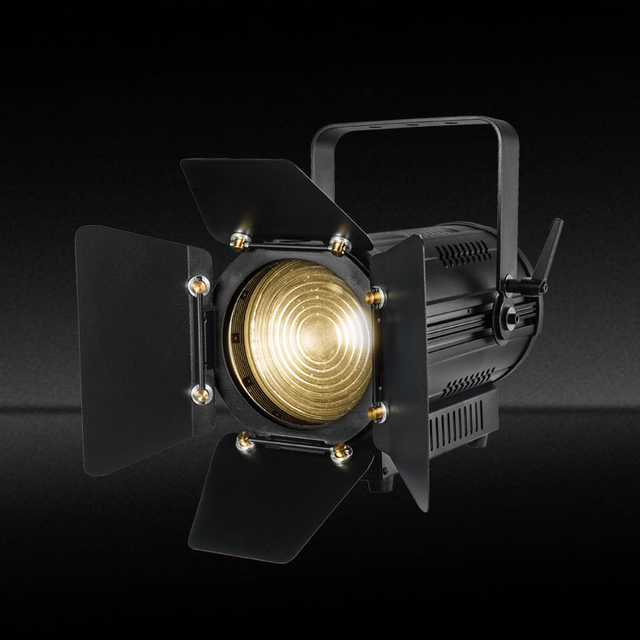
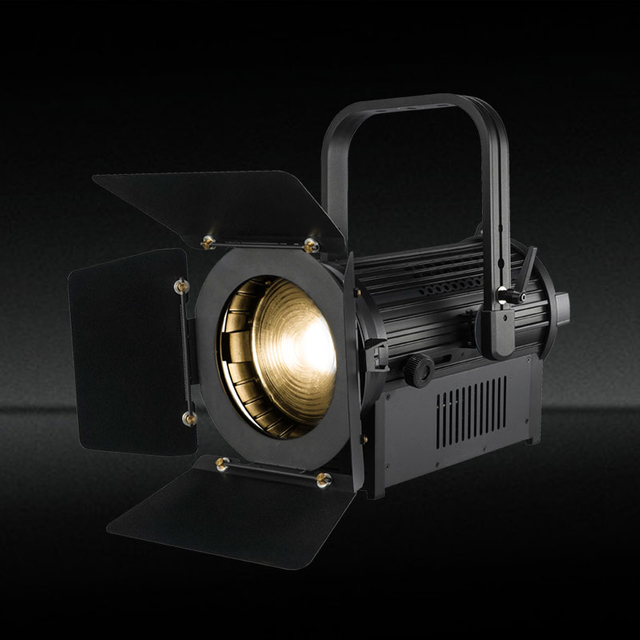
The defining feature of a Fresnel lens is its concentric rings. These rings step down in thickness from the center to the edge. This design creates a unique, soft-edged beam. It gently wraps light around human subjects. The resulting illumination minimizes harsh facial shadows. This is especially crucial during dramatic monologues or dialog-heavy scenes. Directors rely on this soft wrap to keep actors looking natural. The beam avoids the severe, clinical look often associated with bare lenses.
Seamless Stage Washes
Stage lighting rarely relies on a single fixture. You often need to illuminate the entire performance area evenly. This requires overlapping beams from multiple angles. A traditional spotlight creates a hard edge. If you overlap hard edges, you get noticeable hot spots and dark gaps. The led fresnel light solves this through gradual light falloff. The soft edges feather together perfectly. You can blend multiple fixtures across a wide stage. They will not produce visible hard lines. This creates a flawless base wash for your production.
Dynamic Backlighting and Top Lighting
Lighting designers frequently position these fixtures above and behind the performers. Using them as a backlight creates essential visual depth. It separates the actors from the physical backdrop. Because the edge remains soft, this separation feels organic. It does not create severe, unnatural silhouettes. When used as top lighting, the fixtures illuminate hair and shoulders gently. They provide dimension without casting distracting floor shadows.
On-the-Fly Color Mixing
Modern LED technology revolutionizes how we handle stage color. Advanced fixtures utilize RGBW or 6-in-1 (RGBALC) diode engines. Designers can shift hues instantly directly from the control console. You can program a warm, tungsten-mimicking glow for an intimate scene. Seconds later, you can transition to vivid, saturated colors for a high-energy musical number. You no longer rely on physical color gels. This operational advantage speeds up technical rehearsals significantly. It also expands creative possibilities during live performances.
Fixture Showdown: LED Fresnel vs. LED PAR vs. Ellipsoidal
The Framing Problem
You must understand the limitations of your equipment. Fresnels cannot project sharp edges. They cannot project physical patterns or Gobos. The stepped lens inherently diffuses the beam. Sometimes a production requires a hard cut off a set piece. Other times you need a sharp, defined spotlight on a single prop. In these situations, an Ellipsoidal (Leko) is the necessary tool. It features internal shutters and objective lenses to deliver precise framing.
Fresnel vs. LED PAR
Buyers often confuse the applications of Fresnels and PARs. Both are essential, but they serve different purposes.
Beam Quality: PARs (Parabolic Aluminized Reflectors) typically output a harder, punchier beam. This intense beam pushes through tight spaces effectively. It works exceptionally well for aggressive color washes on scenery. Fresnels provide superior edge softness. They render human skin tones much more naturally.
Control Methods: Fresnels offer mechanical or motorized zoom capabilities. You can transition from a tight Spot to a wide Flood instantly. They also respond extremely well to external barn doors for spill control. PARs generally rely on interchangeable front lenses. They use diffusion filters to alter beam spread. Adjusting a PAR requires physical intervention at the fixture.
Decision Logic
System integrators should follow a straightforward rule of thumb. Use Fresnels for your base stage wash and for illuminating human subjects. Use PARs for architectural lighting, set coloration, and bold aerial effects. Use Ellipsoidals when you need precise textures, crisp gobos, and exact framing.
Fixture Type | Edge Quality | Best Used For | Control Mechanism |
|---|---|---|---|
LED Fresnel | Soft, gradual falloff | Front wash, face lighting, backlighting | Internal zoom, Barn doors |
LED PAR | Punchy, moderately hard | Set coloration, bold aerial effects | Interchangeable lenses, Diffusion |
Ellipsoidal (Leko) | Sharp, highly defined | Gobo projection, precise framing | Internal shutters, Focus barrels |
The Business Case: Facility Impact
HVAC and Thermal Load Reduction
Lighting choices directly affect building infrastructure. Traditional tungsten halogens convert approximately 70% of their consumed energy into raw heat. A rig containing fifty 1000W tungsten fixtures generates massive thermal loads. This creates uncomfortable conditions for performers. It also forces backstage HVAC systems to run constantly. LED alternatives drastically lower ambient stage temperatures. They convert electricity into light far more efficiently. This directly reduces backstage air conditioning operational costs. It also prevents performer fatigue during long rehearsals and performances.
Consumables and Maintenance
Facility managers know the hidden costs of legacy systems. Traditional lighting requires a constant supply of halogen replacement lamps. These lamps burn out frequently and require manual swapping at high elevations. Additionally, the extreme heat degrades traditional polycarbonate color gels rapidly. Dark blue or red gels often burn through in just a few weeks. Switching to diode arrays eliminates these repetitive consumable costs entirely. Your maintenance staff can spend less time climbing ladders and more time improving the venue.
Lifespan Metrics (L70 Standard)
You should approach manufacturer lifespan claims with caution. Ignore generic statements like "lasts 50,000 hours." Instead, look for verified L70 specifications. The L70 standard measures the operational hours before a diode depreciates to 70% of its initial light output. A fixture may still turn on after 60,000 hours. However, if it only outputs 50% of its original brightness, it is functionally useless for a stage wash. Prioritize brands that provide transparent L70 testing data.
Key Evaluation Criteria When Shortlisting an LED Fresnel Light
Low-End Dimming Smoothness
You must scrutinize dimming curves. Low-end dimming acts as the ultimate stress test for theatrical LEDs. Traditional tungsten dims flawlessly down to zero. LEDs use Pulse Width Modulation (PWM) to dim. Inferior PWM components cause the light to "step" noticeably. The fixture might instantly snap off when fading through the critical 3% to 0% range. This destroys dramatic theatrical blackouts. Always test the bottom 5% of the dimming curve in a dark room.
Color Rendering Accuracy (CRI and TLCI)
Your lighting must reproduce colors faithfully. A Color Rendering Index (CRI) score above 90 is non-negotiable for stage productions. Anything lower will make costumes look dull and skin tones look unnatural. Furthermore, modern stages are frequently filmed for broadcast or live streaming. If cameras record your stage, you must check the TLCI (Television Lighting Consistency Index). High TLCI ratings prevent skin tone distortion on camera. They save video editors countless hours of color correction.
Acoustic Profile (Fan Noise)
High-output diodes generate heat at the circuit board level. They require internal cooling mechanisms. Most high-wattage fixtures use active cooling fans. You must evaluate the decibel rating of these fans. A single fan might seem quiet. A rig of forty fixtures can sound like a jet engine. For intimate black-box theaters or quiet dramatic plays, acoustic discretion is paramount. Buyers should seek out ultra-quiet fans or opt for specialized passive-cooling (fanless) models.
Zoom Range Flexibility
A wider zoom range increases the versatility of your inventory. Standard models might offer a 15° to 60° beam angle. This flexibility allows one fixture to serve multiple roles.
Spot Mode (e.g., 15°): Perfect for long-throw applications or isolating a single speaker at a podium.
Mid Mode (e.g., 30°): Ideal for overlapping general stage washes from a front-of-house position.
Flood Mode (e.g., 60°): Excellent for short-throw backlighting or washing large set pieces from close range.
Maximizing zoom flexibility potentially reduces the total number of individual fixtures required in your rig.
Migration Risks: Upgrading from Tungsten to LED
DMX Channel Bandwidth Limitations
System integrators often underestimate data requirements during retrofits. A traditional tungsten fixture requires exactly one DMX channel to control its brightness. A multi-color diode array changes this math dramatically. A single RGBW fixture can require 4 to 10 DMX channels. It needs separate channels for red, green, blue, white, master dimmer, strobe, and zoom. A standard DMX universe holds 512 channels. Replacing fifty tungsten lights with fifty RGBW units will exponentially increase your DMX channel usage. You may need to install additional data nodes and splitters.
Console Processing Power
Your control console must handle the increased workload. Older lighting desks were designed to manage simple dimmer racks. They may lack the processing power required for advanced color mixing across dozens of LED units. They might also lack the user interface needed to easily manage pixel-mapping. Before purchasing new fixtures, verify your console capabilities. Ensure it has the correct fixture profiles built into its software library.
Weight and Infrastructure
Do not assume modern technology is always lighter. Legacy lighting consisted of a metal housing, a reflector, and a glass lens. Modern fixtures contain integrated power supplies, heavy aluminum heat sinks, and complex circuitry. This added internal hardware can make them heavier than their traditional counterparts. You must review your facility infrastructure before installation.
Check load limits: Verify the maximum weight rating of your overhead pipes and motorized trusses.
Update rigging hardware: Ensure C-clamps and mounting yokes are rated for the heavier equipment.
Implement safety protocols: Always attach heavy-duty safety cables to secure fixtures in case a primary clamp fails.
Conclusion
The Led Fresnel Light remains the undisputed champion of the soft theatrical wash. It has evolved beautifully. It now augments traditional optical softness with the extreme efficiency and color flexibility of modern diode technology. This combination gives lighting designers unprecedented creative freedom while solving major facility infrastructure challenges.
To ensure a successful upgrade, technical directors and buyers should take practical action. We advise requesting side-by-side fixture shootouts in your actual venue. Specifically test the low-end dimming curve in a dark space. Listen closely to fan noise levels. Evaluate skin-tone rendering on human subjects using cameras. Taking these next steps before committing to a full rig replacement guarantees you invest in the right technology for your specific stage.
FAQ
Q: Can an LED Fresnel light be used as a spotlight?
A: Yes, when zoomed into its tight "spot" mode, it provides a highly concentrated beam. This works well for isolating actors or set pieces. However, unlike a dedicated follow-spot or Ellipsoidal, the beam edges will remain inherently soft. It cannot produce a sharply defined, hard circle.
Q: Do LED Fresnels still need barn doors?
A: Yes. While modern fixtures do not output the extreme forward heat of tungsten, barn doors remain essential optical accessories. They are critical for flagging off light spill. You need them to keep stray light off proscenium arches, scenery, curtains, or the front row of the audience.
Q: What is the difference between an LED Fresnel and an open-face light?
A: Open-face lights lack a front lens entirely. This results in a harsher shadow and a highly uncontrollable, wide beam. A Fresnel lens specifically organizes and bends the raw light rays. This creates a uniform, controllable field with a very smooth, flattering falloff.