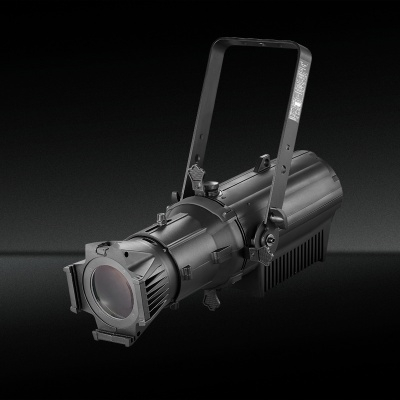
What Is An LED Profile Spotlight Used For In Stage Lighting?
Views: 2 Author: Site Editor Publish Time: 2026-06-05 Origin: Site


Upgrading venue lighting or designing a new stage plot demands careful balance. You must weigh artistic aesthetic goals against harsh operational realities. Standard wash lights often create frustrating visual problems. Older halogen fixtures bring unwanted light spill and steep energy costs. They also flatten performer features, creating a dreaded "washout" effect. You need a better solution to regain visual control.
Introduce the Led Profile Spotlight as your definitive tool. It provides precision light shaping and high-CRI face lighting. It builds structural focal points effortlessly. We will outline exactly what procurement managers must evaluate. Lighting designers will learn how to verify specifications before making major equipment investments.
Key Takeaways
LED profile spotlights deliver hard-edged, precisely controlled beams used primarily for isolating performers, projecting Gobos, and creating sharp theatrical cuts.
Selecting the right fixture requires balancing absolute lumen output against Color Rendering Index (CRI) requirements based on the venue type (e.g., broadcast vs. live concert).
Correct application involves a structured key-to-fill ratio (typically 70/30) when paired with wash lights to maintain stage depth and dimensionality.
Transitioning to LED profiles reduces power consumption by up to 80% compared to traditional halogen ellipsoidals while eliminating consumable costs like color gels.
The Core Functions of an LED Profile Spotlight
A profile spotlight operates differently from standard stage floods. It acts as a surgical instrument for stage lighting. Designers rely on it for absolute control over where light falls. You can direct light precisely where needed and eliminate it where it does not belong.
Precision Framing and Light Shaping
The defining feature of this fixture is its internal framing shutter system. It contains four independently adjustable metal blades. You push these blades into the light path to cut the beam. This mechanical advantage allows you to shape the light into triangles, rectangles, or custom polygons. You can cut light perfectly off a curtain edge. You can illuminate a specific set piece without hitting the projection screen directly behind it. Standard wash lights use barn doors, which produce a blurry, soft edge. Framing shutters guarantee zero unwanted light spill.
Gobo Projection and Texture
Profile lights utilize a highly specialized optical path. This allows them to project crisp, detailed patterns using a Gobo (Go Between Optics). You insert a steel or glass template into the fixture's gate. The lens tube then projects this pattern onto the stage floor or backdrop. This adds instant texture to an otherwise flat scene. You can create the illusion of moonlight filtering through tree branches. You can project sharp corporate logos for B2B events. The distinct focal planes inside the fixture ensure the pattern remains legible and striking.
Variable Edge Control (Focusing)
Modern profile units feature an adjustable lens tube. You can slide this tube forward or backward. This movement changes the focal point of the beam. You can dial it in for a razor-sharp hard edge. Alternatively, you can pull the tube back to deliberately soften the edge. Softening the edge helps blend multiple fixtures together seamlessly across a stage face. Older Plano Convex (PC) spot designs often suffered from a "center dark spot" when adjusted. Modern LED optics eliminate this "hole out" effect entirely. They provide a perfectly flat, even field of light from edge to edge.
Best Practices for Focusing:
Always focus the light to a sharp edge first to find your boundaries.
Once borders are set, soften the edge slightly to blend with neighboring lights.
Lock down the lens knob securely to prevent vibration from shifting the focus.
Primary Stage Applications: Where Profile Fixtures Excel
Different performances demand different lighting approaches. A high-quality Led Profile Spotlight adapts across various disciplines. It serves as the primary workhorse for highlighting human subjects.
Theatrical Key Lighting (Face Light)
Face lighting requires high fidelity. Audiences need to read subtle facial expressions during a drama or musical. Therefore, you must use high-CRI (Color Rendering Index) fixtures. Look for ratings of 90 or above. High-CRI profiles render skin tones accurately. Low-CRI lights make actors look sickly or pale. In broadcast television, you must also check the TLCI (Television Lighting Consistency Index) to ensure cameras capture colors flawlessly without heavy post-correction.
Isolating Performers (Specials)
Designers frequently use these fixtures as "specials." A special is a light dedicated to a single, specific purpose. You might use it to draw the audience's eye to a soloist on a dark stage. You might highlight a crucial prop on a table. Because the profile light has hard edges, you can isolate the subject perfectly. You achieve this isolation without washing out the surrounding stage floor.
Side Lighting for Dance
Dance productions rely heavily on side lighting. When you place profile lights at a low angle in the wings, magic happens. The beam cuts horizontally across the stage. It highlights the physical form and movement of the dancers. It sculpts their muscles and costumes through shadow contrast. Profile lights excel here because you can use shutters to keep light off the stage floor. This maintains a dark, dramatic void around the dancers.
Corporate Events and Keynote Stages
Business events have strict technical requirements. Presenters need sharp, anti-glare podium lighting. If a wash light hits a presenter, it often blinds them. It washes out the presentation screen behind them. A profile spotlight cuts the light precisely around the presenter's shoulders. It keeps the background dark. Additionally, precise logo projection is a critical success criterion for brand visibility during these events.
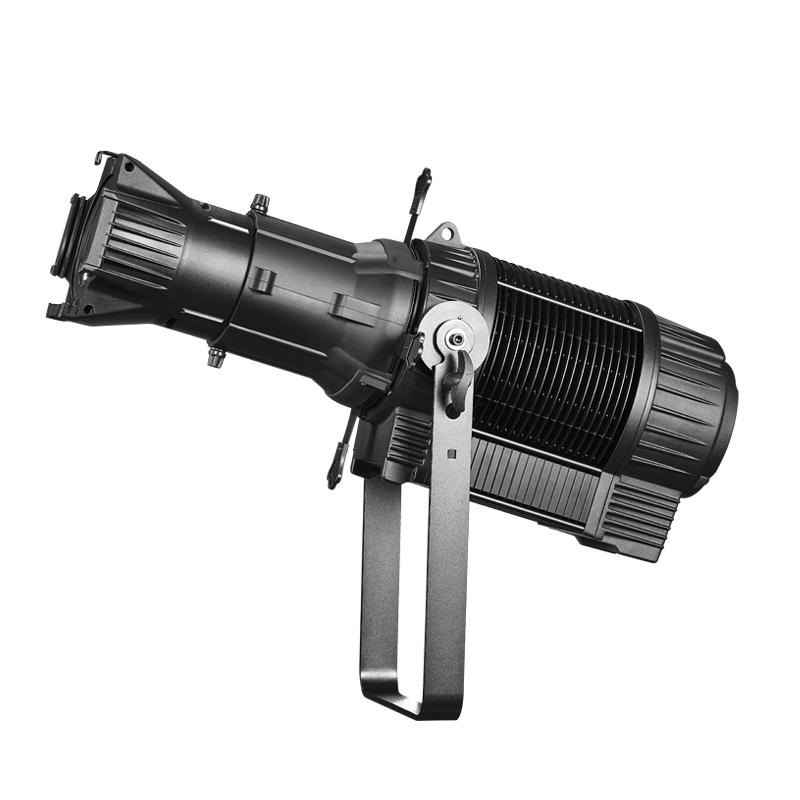
LED Profile Spotlights vs. Stage Floods and Fresnels
Knowing when to use a profile versus a floodlight determines the success of your lighting plot. They serve opposing, yet complementary, purposes.
Comparison Matrix (Form vs. Function)
The following chart summarizes the physical and operational differences between these primary fixture categories.
| Feature | Profile Spotlight | Stage Flood / Fresnel |
|---|---|---|
| Beam Angle | Tight and defined (typically 10°–50°). | Wide dispersion (typically 45°–120°+). |
| Throw Distance | Excels at long-throw distances. | Best for short-to-medium distances. |
| Edge Quality | Defined borders, razor-sharp cuts. | Stepped, inherently soft, and blending edge. |
| Beam Control | Internal framing shutters, Gobos, irises. | External barn doors, top hats. |
Avoiding the "Washout Effect"
Using only floodlights introduces a severe operational risk. Floodlights blast illumination evenly across the entire stage. This destroys shadows. Without shadows, faces look flat and two-dimensional. We call this the "washout effect."
To avoid this, you must apply the standard key-to-fill rule. Your profile spotlight acts as the key light. Your wash acts as the fill light. The profile key light should typically be 30% brighter than the wash. This 70/30 ratio maintains facial dimensionality. It ensures the performer pops out from the background.
When to Call on Which
Apply strict shortlisting logic during the design phase. If your goal is general ambiance or stage color washing, use a Fresnel or Flood. If your goal involves strict boundary control, feature highlighting, or pattern projection, you must specify a profile fixture.
Key Technical Criteria for Venue Procurement
Procurement teams face a massive catalog of options. You must look past basic marketing claims. Focus on verifiable technical specifications to match the fixture to your specific venue.
The Output vs. CRI Trade-off
Many buyers fall into a common industry blind spot. They want maximum brightness and perfect color. In reality, physics demands a trade-off. Achieving a high CRI (>90 or 95) requires a heavier phosphor coating on the LED chip. This coating absorbs some light to correct the color spectrum. Therefore, high-CRI fixtures often have a slightly lower absolute lumen output.
Theaters and broadcast studios must prioritize CRI and TLCI. Perfect skin tones are non-negotiable. Conversely, large outdoor rock concerts can prioritize maximum raw output. They can accept a slightly lower CRI because sheer punch through atmospheric fog matters more.
Wattage Mapping to Venue Size
Over-speccing wastes budget. Under-speccing leaves performers in the dark. Use the following sizing framework to map wattage to your physical space appropriately.
| Wattage Category | Best Suited Venue Types | Primary Application |
|---|---|---|
| 150W | Small theaters, intimate acoustic stages, local studios. | Short-throw face lighting, close-range specials. |
| 200W – 250W | Medium-to-large theatrical venues, houses of worship. | Standard stage washes, mid-house balcony throws. |
| 300W+ | Large-scale arenas, outdoor broadcast events. | Long-throw Front-of-House (FOH) positions, heavy color saturation. |
Optical Quality and Color Mixing
Pay close attention to the light engine. Single-source COB (Chip-on-Board) engines provide a beautifully uniform beam. They mimic the single-point source of an old halogen lamp. Multi-color arrays (RGBW or RGBAL) offer incredible color flexibility. The addition of Amber and Lime (AL) fills spectral gaps, creating rich, warm whites.
Furthermore, evaluate the internal components. Emphasize the importance of high-end IC chips. Quality chips ensure consistent dimming curves. They prevent the light from flickering when dimmed. Flicker-free operation is absolutely crucial for video recording and live broadcasts.
Acoustic Management
Thermal management dictates noise levels. LEDs generate heat at the rear heat sink. Cooling fans dissipate this heat. For theatrical and classical music venues, acoustic management is critical. Evaluate the fixture's decibel (dB) rating. A loud fan ruins quiet, dramatic monologues. Look for fixtures offering "studio modes" that throttle fan speed. Alternatively, invest in fan-less, passive-cooling fixtures for near-silent operation.
Common Mistakes in Procurement:
Ignoring the fan noise rating for intimate acoustic spaces.
Buying low-CRI fixtures for broadcast applications.
Purchasing high wattage fixtures for short-throw distances, causing blinding hotspots.
Lifecycle Efficiency and Implementation Considerations
Moving away from traditional halogen systems represents a massive infrastructure upgrade. The benefits extend far beyond simply changing a light bulb. Modern systems streamline daily operations and reduce heavy labor.
Energy and Infrastructure Efficiency
Traditional halogen ellipsoidals draw massive amounts of power. A standard theatrical halogen fixture draws roughly 750 watts. A comparable LED fixture draws only 150 to 200 watts. This lower amperage draw changes your infrastructure completely. You can daisy-chain more fixtures per electrical circuit. This drastically reduces cabling complexity. You no longer need massive, heavy power distribution racks backstage.
Consumables and Maintenance
The operational burden drops significantly with LED adoption. In the past, you had to buy colored plastic gels. These gels burned out quickly and required constant physical replacement. LEDs mix color internally, eliminating disposable gels entirely. Additionally, a traditional halogen lamp burns out after about 2,000 hours. A modern LED engine boasts a life cycle of up to 50,000 hours. You eliminate frequent lamp replacements. Your technicians spend less time climbing ladders for basic maintenance.
Protocol Integration (DMX/RDM)
Modern fixtures communicate intelligently. Standard DMX protocols handle dimming and color mixing directly inside the fixture. You do not need external, wall-sized dimmer racks anymore.
More importantly, highlight the necessity of RDM (Remote Device Management). RDM allows bidirectional communication. Your lighting console can ping rigged fixtures remotely. You can check temperatures, assign DMX addresses, and troubleshoot errors from the ground. This reduces labor hours drastically during tight show turnarounds.
Conclusion
An LED profile spotlight is not a tool for general illumination. It is a precision instrument designed for shaping audience focus. It guarantees high-fidelity color rendering and sharp beam control. Upgrading your venue requires matching exact technical specifications with your architectural layout.
Prioritize CRI and TLCI ratings over raw brightness for theatrical and broadcast spaces.
Use a 70/30 key-to-fill ratio to avoid flattening your performers.
Verify the thermal management and acoustic noise levels before installing fixtures in quiet venues.
Leverage RDM protocols to simplify rigging and remote troubleshooting.
Your next step is verification. Advise your procurement teams to request photometric data sheets. Always acquire physical demo units first. Test the beam uniformity, color mixing, and fan noise within your specific venue. Only then should you commit to a full stage rig upgrade.
FAQ
Q: Can I swap my old halogen ellipsoidal lenses onto a new LED profile spotlight engine?
A: Yes, in many cases. Several manufacturers design modern LED engines to accept industry-standard halogen lens tubes. This backward compatibility saves significant budget. You only purchase the LED body and reuse your existing optical inventory.
Q: What is the difference between a static LED profile and a moving head profile?
A: Static profiles rig into fixed positions like Front-of-House (FOH) trusses. They provide stable, fixed focal points. Moving head profiles contain internal motors. You use them for dynamic stage effects, fast repositioning mid-show, and complex automated tracking.
Q: Do LED profile spotlights require external dimmers?
A: No. LED fixtures feature built-in electronic dimming. You provide them with constant, direct power. You control the dimming intensity via a DMX data cable from your lighting console. This renders traditional heavy dimmer racks obsolete.